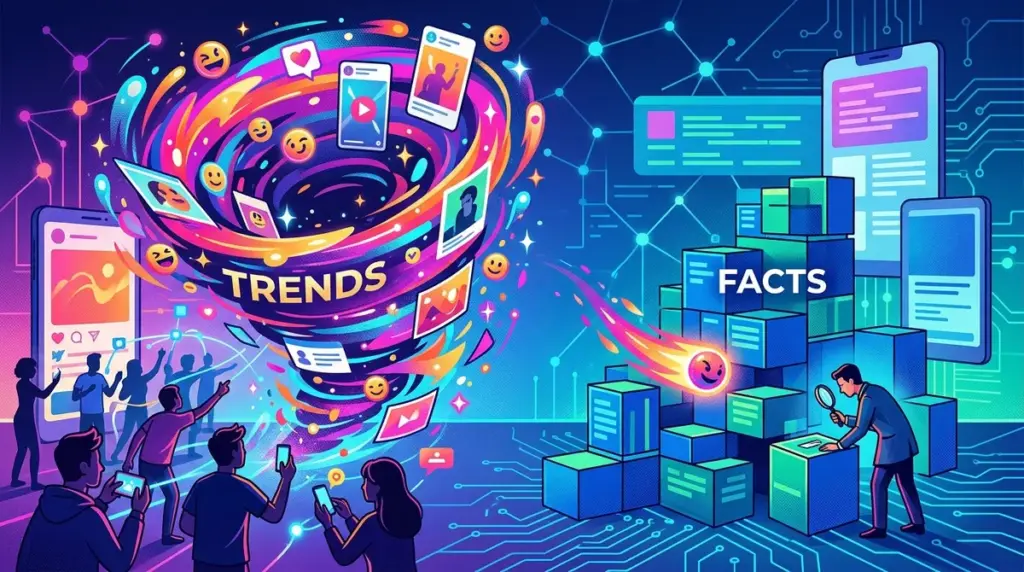
In the digital attention economy, the interval between a cultural spark and a global wildfire is now measured in minutes, not days. For marketers and publishers, this creates a high-stakes friction point: the commercial necessity of speed versus the reputational requirement for accuracy. Trends are liquid; they adapt, flow around obstacles, and fill voids instantly. Facts are solid; they require structure, verification, and time to set. In a landscape where platform algorithms prioritize "velocity of engagement" over "depth of accuracy," the liquid always wins the race to the feed. This algorithmic prioritization is a key factor in understanding the dynamics of online information, particularly how recommendation feeds shape discovery.
The Algorithmic Preference for Velocity
Social media algorithms are not designed to be arbiters of truth; they are designed to be engines of retention. When a piece of content—be it a meme, a speculative headline, or a TikTok challenge—starts to gain traction, the system recognizes a high "signal-to-noise" ratio in terms of user interaction. To maximize time-on-site, the algorithm pushes this high-velocity content to wider circles of users before any human or automated fact-checking process can intervene.
Best for: Social media managers and growth hackers who need to understand why "perfect" content often fails while "fast" content thrives.
This creates a feedback loop. Because the algorithm rewards early engagement, creators are incentivized to post first and verify later. This "first-mover advantage" in the information space means that by the time a fact-check is published, the trend has already reached its peak and begun to decay. The factual correction rarely possesses the same viral DNA as the original trend because it lacks the novelty and emotional charge that triggered the initial spread.
The Low Cognitive Load of Trending Content
Facts are often nuanced, boring, and require cognitive effort to process. Trends, conversely, are designed for "low-friction" consumption. They rely on visual shorthand, emotional triggers, or existing cultural tropes. When a user scrolls through a feed, they are more likely to share something that reinforces their identity or makes them feel "in the know" than something that requires them to read a 1,000-word white paper. The social currency gained from being an early adopter of a trend is immediate; the reward for sharing a verified fact is often non-existent or delayed.
Warning: Brand safety is the first casualty of trend-jacking. Jumping on a high-velocity trend without verifying its origin can link your brand to problematic subcultures or misinformation that persists long after the trend dies.
The Economics of Social Currency and Tribalism
In the creator economy, trends act as a form of social glue. Sharing a trending topic signals membership in a specific digital tribe. Whether it is a new AI tool, a niche fashion aesthetic, or a startup pivot, participating in the conversation provides immediate validation. Facts, however, can be divisive or inconvenient to the narrative a tribe has built. When a fact contradicts a trending sentiment, it is often ignored or suppressed by the community because it disrupts the social cohesion the trend provides.
From a commercial perspective, this means that brands that focus solely on "hard data" often find themselves shouting into a vacuum. To be heard, information must be wrapped in the prevailing "vibe" or trend of the moment. This is not about being dishonest; it is about understanding that the medium—and the speed of that medium—dictates the reception of the message.
Strategic Synchronization: Balancing Speed and Accuracy
For agencies and publishers, the goal is not to choose between being fast or being right, but to develop a workflow that allows for "verified velocity." This involves identifying trends in their nascent stage (the "signal" phase) before they reach the mainstream "noise" phase. By the time a trend is a household name, the ROI on content creation has already begun to diminish.
- Trend Mapping: Use social listening tools to identify keywords and sentiment shifts in niche communities (Discord, Reddit, specialized Telegram channels) before they hit the X or TikTok mainstream.
- Modular Content: Maintain a library of verified "fact-blocks" that can be quickly integrated into trending formats, allowing for rapid response without starting research from scratch.
- The "Wait and See" Buffer: Implement a 30-minute verification window for high-stakes trends to ensure the brand isn't walking into a PR minefield.
- Contextual Layering: Instead of just reposting a trend, add a layer of expert analysis that provides value beyond the initial shock factor.
- Iterative Publishing: Post a "live" or "developing" version of a story to capture initial traffic, then update with verified facts as they emerge.
The Infrastructure of Misinformation
It is important to recognize that the speed of trends is often bolstered by "bot-nets" and coordinated engagement groups. These entities can manufacture the appearance of a trend, tricking both algorithms and human editors into believing a topic is more significant than it is. This is why data-driven verification is essential. A trend that lacks a diverse source of origin—meaning it is only being discussed by a specific cluster of suspicious accounts—is a trend that will likely collapse or result in a factual "correction" shortly after.
Building a High-Velocity Editorial Engine
To compete in an environment where trends move faster than facts, your editorial team must shift from a "reactive" to a "predictive" stance. This means investing in data analysts who can distinguish between organic cultural movements and manufactured viral peaks. It also requires a cultural shift within the organization: moving away from the "finality" of print-style publishing toward a more fluid, digital-first approach where content is a living document.
Focus on "Truthful Engagement." This involves taking the core of a factual message and distilling it into the high-velocity formats that platforms crave—short-form video, infographics, and punchy, thread-based narratives. If the facts don't move as fast as the trends, it is usually because the facts are poorly packaged for the modern web.
Frequently Asked Questions
How can a brand participate in trends without risking its reputation?
The most effective method is "Contextual Trend-Jacking." Instead of mimicking a trend exactly, use the trend as a hook to discuss a verified topic within your niche. This allows you to capture the velocity of the trend while maintaining the authority of your factual content.
Why do corrections to fake trends never get the same reach?
Algorithms prioritize novelty and high-arousal emotions (like anger or surprise). A correction is inherently "second-hand" information and usually carries a lower emotional charge, making it less likely to be shared by users or promoted by the platform’s recommendation engine.
What are the best indicators that a trend is worth following?
Look for "Cross-Platform Resonance." If a topic is moving from Reddit to X to TikTok simultaneously, it has more staying power than a trend confined to a single platform. Additionally, check the "Velocity of Sentiment"—if the conversation is evolving and adding new layers of context, it is likely a legitimate cultural shift rather than a fleeting bot-driven spike.
Does SEO still matter when trends move this fast?
Yes, but the strategy shifts from long-tail keywords to "Query Deserves Freshness" (QDF) optimization. For fast-moving trends, being the first to provide a structured, factual answer to a new trending search query can result in a massive, albeit temporary, traffic spike that boosts your domain authority for the long term.