
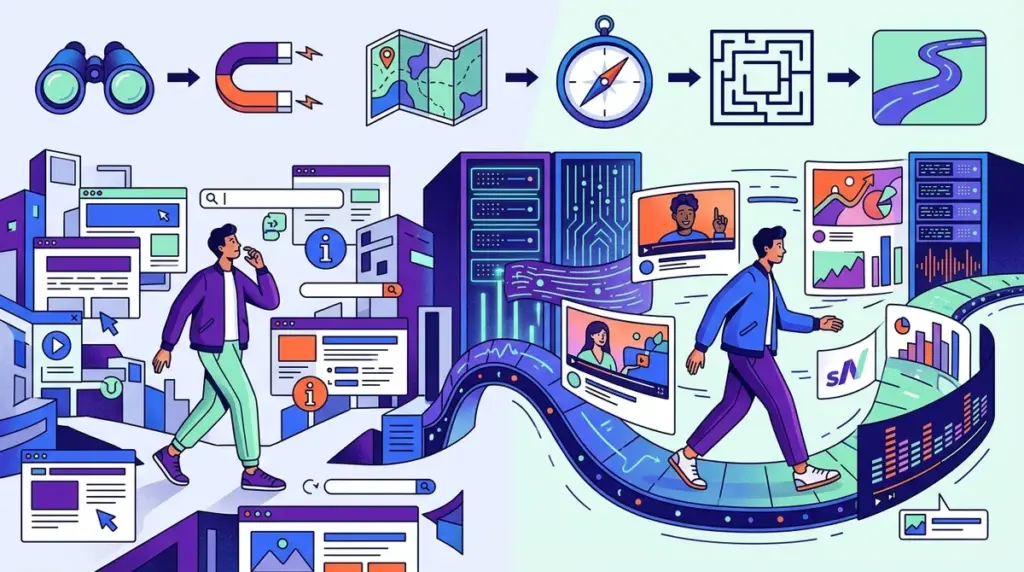
Search is no longer a proactive behavior; it is an ambient state. For the better part of two decades, online discovery was governed by the query—a deliberate act of intent where a user typed a specific phrase into a box and received a list of ranked results. Today, that model has been largely supplanted by the recommendation feed. Whether it is TikTok’s "For You" page, YouTube’s sidebar, or Instagram’s Reels, the burden of discovery has shifted from the user to the machine. For marketers and publishers, this represents a fundamental change in how traffic is acquired and how brand authority is built. This shift also amplifies the stakes, as understanding the platform risk creators face becomes paramount for sustained visibility.
Best for: Digital strategists, e-commerce founders, and content creators looking to pivot from traditional search intent to algorithmic resonance.
The Architecture of Passive Discovery
The transition from "pull" to "push" media is driven by sophisticated vector embeddings and real-time feedback loops. In a traditional search environment, discovery is limited by the user’s vocabulary. If they don't know a product exists, they cannot search for it. Recommendation feeds bypass this limitation by analyzing behavioral signals—dwell time, rewatch rates, and micro-interactions—to map a user’s latent interests.
This shift has democratized reach but increased volatility. In the old model, a high-ranking position on a search engine results page (SERP) offered a predictable stream of traffic. In the feed model, every piece of content must earn its distribution in real-time. The algorithm tests a video or article against a small seed audience; if the engagement signals are high, the distribution scales exponentially. If they are low, the content dies regardless of the account’s follower count.
From Social Graphs to Interest Graphs
The most significant technical shift in discovery is the death of the social graph in favor of the interest graph. Early social media relied on who you followed to determine what you saw. Modern discovery engines ignore your social connections and focus entirely on the content’s attributes. This means a brand with zero followers can achieve millions of impressions if the content aligns with a specific algorithmic cluster. This has forced a pivot in strategy: instead of building an audience, brands must now build "signals" that the algorithm can categorize and distribute.
The Commercial Reality of the Infinite Scroll
For e-commerce and SaaS, the recommendation feed has shortened the distance between discovery and conversion. Because the feed is predictive, it often surfaces solutions before the user has fully articulated their problem. This is "discovery commerce." It relies on high-frequency, high-signal content that triggers an emotional or utilitarian response within the first three seconds.
However, this environment rewards novelty over loyalty. Users are no longer loyal to a specific source; they are loyal to the quality of the feed itself. This creates a "leaky bucket" problem for publishers. While a viral hit can bring a massive spike in visibility, converting that anonymous feed traffic into owned data (like email subscribers or app installs) is significantly harder than it was in the era of intent-based search.
Warning: Do not mistake viral reach for brand equity. High-velocity feed distribution often lacks "source attribution," meaning users may consume your content without ever registering your brand name. Every piece of feed-optimized content must include a distinct visual or narrative signature to ensure the brand remains the focal point, not just the entertainment.
Optimizing for the Feed: A New Framework
Traditional SEO focuses on keywords and backlinks. Feed optimization focuses on retention and "stop power." To succeed in a discovery-first environment, content must be engineered to satisfy the algorithm's appetite for high-engagement signals. This requires a shift in production values and metadata strategy.
- Retention Hooks: The first 1.5 seconds must provide a visual or cognitive "pattern interrupt" to stop the scroll.
- High-Signal Metadata: Using specific hashtags and descriptions that act as "anchors" for the algorithm to categorize the content's niche.
- Contextual Relevance: Content must feel native to the platform’s specific UI/UX. Repurposed TV commercials or static blog posts fail because they signal "ad" to the user's brain.
- Engagement Velocity: The speed at which users interact with the content in the first hour determines its total reach.
The Erosion of Intent-Based Moats
In the past, a company could own a "category" by dominating the top three spots for a high-volume keyword. Recommendation feeds have eroded these moats. Now, a competitor can enter the market and achieve parity in visibility almost overnight by producing content that resonates with the same interest clusters. This puts a premium on creative execution and data-driven iteration. You are no longer competing against other companies; you are competing against every other piece of content in the user's feed for their limited attention span.
Measuring Success in a Feed-First World
The metrics that mattered in 2015—pageviews and bounce rate—are increasingly irrelevant for discovery feeds. Modern marketers must look at deeper engagement data to understand if their content is actually moving the needle. Completion rate is the new "gold standard" metric; if a user watches 90% of a video or reads a long-form thread to the end, the algorithm views that as a successful match and will find more users like them.
Furthermore, "shareability" has replaced "link-building." When a user shares a piece of content within the platform, it provides a massive boost to the recommendation engine’s confidence score. This is a purely organic signal that cannot be easily gamed, making it the most valuable currency in the discovery ecosystem.
Implementing a Discovery-First Strategy
To capitalize on the shift toward recommendation feeds, businesses must move away from static content calendars and toward a high-velocity testing model. Start by identifying the "interest clusters" your target audience inhabits. Instead of asking "What are they searching for?", ask "What are they already consuming?" and "What is missing from that experience?"
Focus on producing content that is "algorithmically legible." This means the subject matter, the visual cues, and the audio signals are all aligned so the machine knows exactly who to show it to. Finally, ensure that your conversion path is frictionless. If a user discovers you in a feed, they are likely on a mobile device and in a "lean-back" state of mind. Your landing page must be optimized for that specific context—fast, mobile-first, and requiring minimal input to complete a transaction.
FAQ
How does feed discovery differ from traditional SEO?
Traditional SEO is reactive, responding to specific user queries. Feed discovery is proactive, pushing content to users based on behavioral patterns and interest graphs, regardless of whether they are actively looking for it.
Can small brands compete with large budgets in recommendation feeds?
Yes. Because interest graphs prioritize engagement signals over brand authority or spend, a well-executed piece of content from a small creator can outperform a high-budget ad from a major corporation if the smaller creator better understands the platform’s nuances.
What is the most important metric for feed-based content?
Retention and completion rate. Algorithms prioritize content that keeps users on the platform. If your content has a high drop-off rate in the first few seconds, its distribution will be throttled, regardless of its quality or relevance.
Does traditional search still matter?
Absolutely. Search remains the primary tool for high-intent, bottom-of-funnel conversions. Recommendation feeds are best used for top-of-funnel discovery and brand awareness, while search captures users who are ready to buy or solve a specific problem.