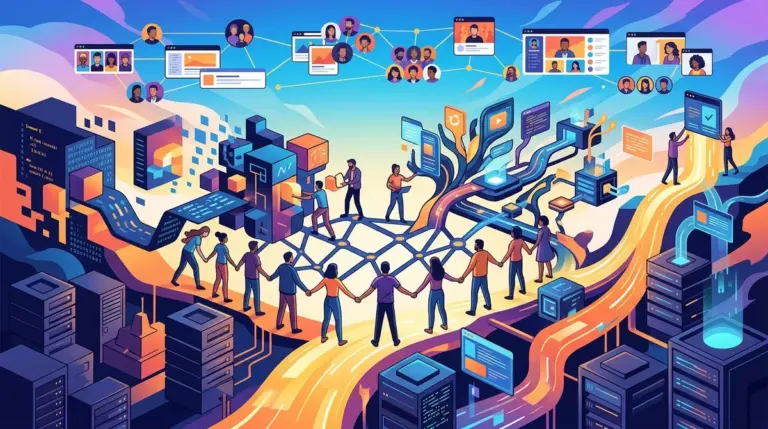

Traditional media operates on a broadcast model: one voice speaking to many, measured by the blunt instrument of impressions. This model is failing because it lacks a feedback loop. In its place, community builders have emerged as the new power brokers of digital business. These figures do not just publish content; they facilitate ecosystems where the audience talks back, collaborates, and self-identifies through shared goals. For brands and creators, this shift represents a move from renting attention via algorithms to owning it through direct relationships.
The Erosion of the Broadcast Monopoly
The decline of the traditional media outlet is a direct result of the "trust deficit." When information is infinite, the value of a generic news cycle drops to zero. Community builders solve this by acting as filters. They provide curated environments where the signal-to-noise ratio is managed by human moderation rather than a black-box algorithm. This makes them more valuable to advertisers and partners because their "reach" is high-intent and verified. This distinction is key to understanding what makes a community truly engaged and loyal to its leaders.
Best for: Startups looking to lower Customer Acquisition Cost (CAC) and publishers facing declining referral traffic from social platforms.
Unlike a traditional editor, a community leader manages a living asset. When a member asks a question in a private Slack or Discord, the answer becomes a piece of micro-content that serves the entire group. This creates a compounding effect where the value of the community increases with every new participant, a dynamic rarely seen in standard editorial publishing where content decays the moment it hits the archive.
Monetizing Trust Over Impressions
The economic engine of community-led media is fundamentally different from the ad-supported web. While a traditional site might chase millions of pageviews to satisfy a programmatic ad network, a community builder can build a multi-million dollar business with 1,000 highly engaged members. This is the "Thousand True Fans" theory applied to modern SaaS and creator economies.
The Feedback Loop as a Product Engine
Community builders have a distinct advantage in product development. They have a direct line to their audience's pain points. If a community of 500 CTOs is constantly complaining about a specific cloud orchestration issue, the community leader has the data needed to launch a consultancy, a software tool, or a targeted job board. This is "media as a laboratory." By addressing these pain points, community builders can create solutions that are among the factors that contribute to community longevity.
Pro Tip: Avoid the "ghost town" effect by seeding your community with 10–20 "founding members" who are incentivized to drive conversation before you open the doors to the public. A community without visible activity is a liability, not an asset.
The Tech Stack of Modern Community Leaders
Building a media empire around a community requires more than just a newsletter. It requires a stack that facilitates both synchronous and asynchronous communication while capturing user data. The goal is to move users away from "rented" spaces like Facebook Groups toward "owned" spaces where you control the data and the notification layer.
- Platform Layer: Circle, Discord, or Slack for real-time engagement and structured discussion.
- Retention Layer: Substack or Beehiiv for long-form editorial that keeps the community aligned on a central narrative.
- Utility Layer: Luma or Eventbrite for hosting workshops and networking events that turn digital connections into real-world relationships.
- Data Layer: A robust CRM to track member activity, identifying "power users" who can be converted into brand ambassadors or high-ticket clients.
Ownership of First-Party Data
As third-party cookies disappear and privacy regulations tighten, first-party data has become the most valuable asset in the digital economy. Community builders own this data. They know exactly who their members are, what they do for a living, what challenges they face, and what they are willing to pay for. This level of granularity is impossible to achieve through standard web analytics.
For a business, partnering with a community builder is not just an "ad buy." It is a strategic entry into a pre-vetted network. The community leader acts as a guarantor of quality. If they recommend a tool or a service, the conversion rates are typically 5x to 10x higher than a standard display ad because the recommendation is backed by social capital.
Operationalizing Community Control
To transition from a simple content creator to a community-led media figure, you must stop measuring success by "views" and start measuring it by "contributions." A healthy community is one where the members provide as much value as the founder. This requires a shift in mindset from being a "writer" to being a "facilitator."
Start by identifying a specific, underserved niche. General "business" communities fail because they are too broad. A community for "SaaS founders scaling from $1M to $10M ARR" succeeds because the problems are specific, the members are peers, and the value of the networking is quantifiable. Once the niche is established, focus on "governance"—setting the rules of engagement that prevent the community from devolving into a spam-filled feed.
The future of media is not more content; it is better connection. Those who can build and maintain these connections will hold the keys to the most lucrative segments of the internet economy. They are no longer just "influencers"; they are the infrastructure of the modern digital landscape.
Frequently Asked Questions
How do community builders differ from traditional influencers?
Influencers focus on a parasocial relationship where the audience watches the creator. Community builders focus on the relationships between the members themselves, creating a network effect that doesn't rely solely on the founder's daily output.
What is the most effective way to monetize a small community?
Tiered memberships are the most direct route. Offer a free layer for broad reach, a paid layer for exclusive content and networking, and a high-ticket "mastermind" or advisory layer for deep, personalized access and problem-solving.
Which platform is best for a professional community?
Circle is currently the industry standard for professional, organized communities that require a clean UI and integrated course hosting. Slack is better for high-frequency, real-time networking, while Discord is preferred for developer-centric or high-volume creative groups.
How do you prevent community burnout?
Delegation is key. As the community grows, appoint "moderators" or "ambassadors" from within the most active member base. This decentralizes the workload and gives the members a sense of ownership over the space's success.