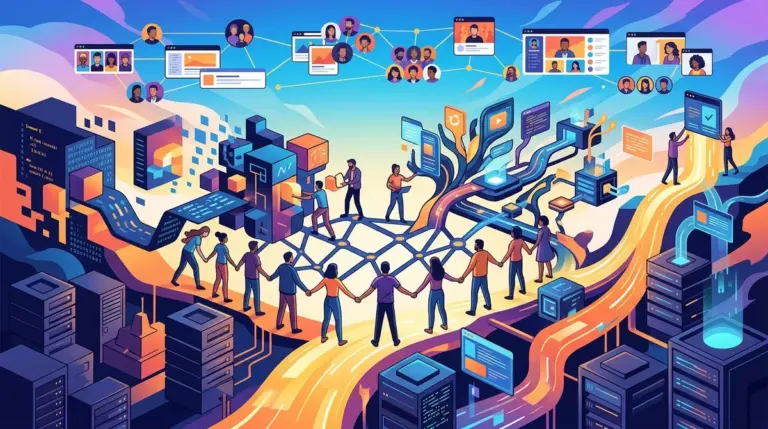
Most digital strategies fail because they mistake a subscriber count for a moat. In the current attention economy, an audience is a marketing expense, while a community is a capital asset. For startups and creators, the distinction isn't semantic—it is financial. An audience is a group of people who consume your content; a community is a group of people who interact with each other around your brand. One provides reach, the other provides resilience. This shift highlights how community-led growth is transforming the internet, moving beyond simple reach to build lasting value.
Best for: Founders and marketing leads deciding between high-volume top-of-funnel growth and high-retention product-led ecosystems.
The Directional Flow of Information
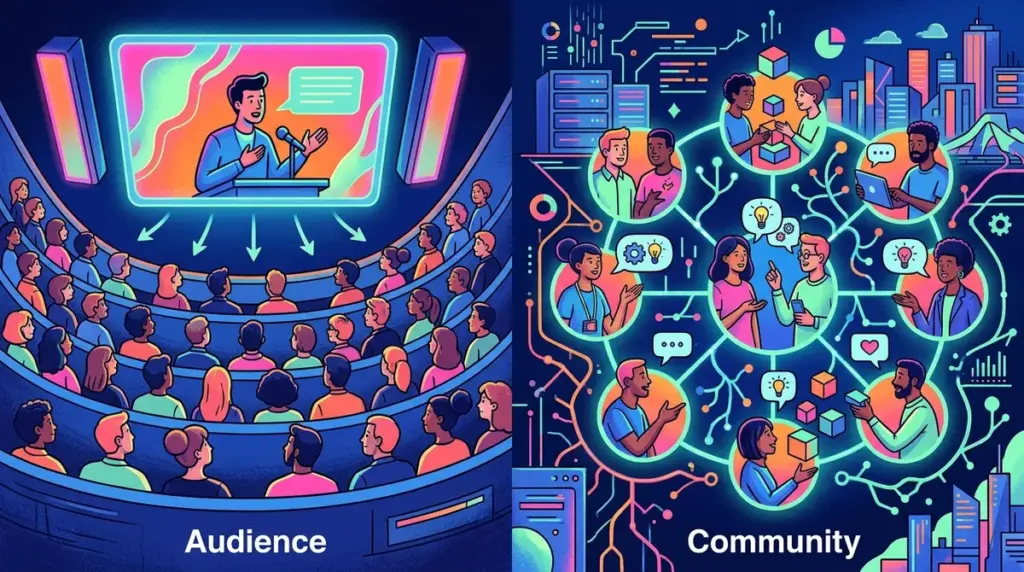
The primary differentiator between an audience and a community is the direction of communication. An audience operates on a hub-and-spoke model. Information flows from the center (the brand or creator) outward to the nodes (the followers). This is a broadcast relationship. If the central node stops speaking, the network goes silent. This creates a high-maintenance content treadmill where the brand must constantly produce to remain relevant.
A community operates on a mesh network model. While the brand may facilitate the space, the primary value is generated through peer-to-peer interaction. In a community, members answer each other's questions, share independent use cases, and form sub-groups. This decentralization means the brand no longer has to be the sole source of value, significantly reducing the long-term cost of engagement.
Audience as a Distribution Channel
An audience is optimized for scale and discovery. It is built on platforms like TikTok, LinkedIn, or via SEO-driven blogs where the goal is maximum impressions. Commercially, an audience is a "rented" asset. You are subject to the algorithmic whims of the platform. If a social network changes its feed logic, your access to that audience can drop by 90% overnight. The value of an audience lies in its ability to drive traffic to a conversion point, such as a sales page or a lead magnet.
Community as a Product Feedback Loop
A community is a "owned" or "semi-owned" asset, typically housed on platforms like Discord, Slack, or proprietary forum software. The commercial value here is not reach, but depth. A community provides a real-time focus group for product development. When a SaaS company has an active community, the users often provide the technical support that would otherwise require a paid headcount. They identify bugs, suggest features, and act as a defensive barrier against competitors by creating high switching costs through social ties.
Metrics that Distinguish Reach from Retention
To manage these two entities effectively, you must measure them using different KPIs. Using audience metrics to judge a community will make the community look like a failure, and vice versa.
- Audience KPIs: Unique visitors, click-through rate (CTR), cost per thousand impressions (CPM), and follower growth rate. These measure the efficiency of your megaphone.
- Community KPIs: Active participation rate (members talking to members), net promoter score (NPS), churn reduction, and the "contribution ratio" (the percentage of members creating content versus consuming it).
- Governance: Audiences require moderation to prevent spam; communities require facilitation to encourage leadership among members.
- Value Proposition: An audience wants to be entertained or informed; a community wants to belong or achieve a specific transformation.
- Ownership: You "own" the attention of an audience for seconds; you "own" the relationship with a community for years.
Pro Tip: Do not attempt to turn an audience into a community until you have a clear "connective tissue." If your followers have no reason to talk to each other without you in the room, you don't have a community—you have a crowd. Force-feeding a community structure onto a passive audience usually results in a ghost-town Slack channel.
The Financial Impact on Customer Acquisition Cost (CAC)
From a commercial perspective, the transition from audience to community is a play for efficiency. High-growth startups often burn venture capital to acquire an audience through paid ads. This creates a linear relationship between spend and growth. To get more customers, you must spend more money.
A community breaks this linear dependency. Because members recruit other members and provide organic social proof, the Customer Acquisition Cost (CAC) trends downward over time. Furthermore, the Lifetime Value (LTV) of a community member is significantly higher. Data consistently shows that customers who feel part of a brand's "inner circle" are less price-sensitive and more likely to renew subscriptions. They aren't just buying a utility; they are maintaining a status or a set of relationships.
Operationalizing the Shift from Followers to Members
Moving from a broadcast model to a community model requires a shift in resource allocation. Instead of hiring more content creators to feed the audience, you hire community managers to empower the members. This involves creating "rituals"—recurring events, challenges, or discussions that happen without the founder's direct involvement.
Start by identifying your "Super Users." These are the 1% of your audience who already comment on every post and help others in the mentions. Move them into a private space. Give them direct access to your team and early looks at new features. By empowering this small group to lead, you create the social infrastructure necessary for a self-sustaining community. This is how brands like Notion and Figma turned simple software tools into global movements; they didn't just build a user base, they built a specialized workforce of advocates.
Operationalizing the Distinction
To maximize the ROI of your digital presence, you must treat your audience as the "top of the funnel" and your community as the "bottom of the funnel." Use the audience to capture attention and filter for the right people. Use the community to lock those people in and turn them into brand evangelists. Mixing these two up leads to "community fatigue" (trying to be deep with too many people) or "audience stagnation" (failing to grow because you are too focused on a small group).
Common Questions Regarding Audience and Community
Can an audience exist without a community?
Yes. Most successful media companies and influencers operate purely on an audience model. They focus on high-volume distribution and monetize through advertising. This is a valid business model, but it is highly vulnerable to platform changes.
Which is more expensive to maintain?
Initially, a community is more expensive because it requires high-touch facilitation and specialized software. However, over time, an audience becomes more expensive because you must pay (either in ad spend or content production) for every minute of attention you get.
Should I start with an audience or a community?
Almost always start with an audience. You need a critical mass of people to find the "Super Users" who will form the core of your community. Starting a community with zero audience usually results in an empty platform that discourages new joiners.
What is the best platform for building a community?
It depends on the goal. For professional networking and B2B feedback, Slack or Circle are standard. For real-time engagement and gaming/creator culture, Discord is superior. For high-privacy or niche interests, a self-hosted forum or a dedicated mobile app is best to ensure you own the data.