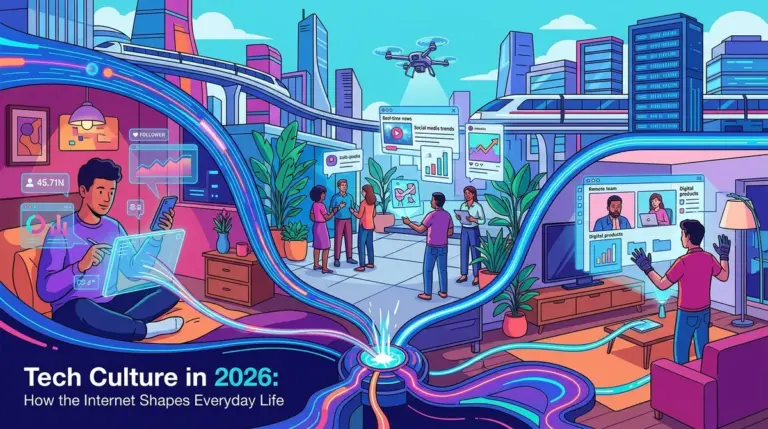
Internet culture now changes on product release cycles, model updates, creator monetization shifts, and platform policy changes. For marketers, founders, publishers, and agency teams, the practical question is not which trend sounds futuristic. It is which shifts are already changing distribution, audience behavior, ad economics, search visibility, and what people expect from digital products. The 12 trends below are ranked by commercial impact in 2026: where attention is moving, what infrastructure is enabling it, and which businesses are positioned to capture value instead of reacting late. This is why understanding how online trends evolve is crucial for businesses to stay ahead.
What to Look For
Prioritize trends that alter at least one of four levers: discovery, conversion, retention, or production cost. A trend matters commercially when it changes how people find content, how cheaply teams can make it, how often users come back, or how much margin a business keeps. That rules out a lot of hype. A consumer app feature may dominate headlines and still have limited business effect. By contrast, a change in AI search interfaces, creator storefronts, synthetic media workflows, or device-level assistants can force publishers, ecommerce brands, and software companies to rebuild distribution strategy within a quarter.
1. Generative AI Search Interfaces
Search is no longer just a list of links. In 2026, answer-first interfaces, conversational search layers, and AI summaries are changing click behavior at the top of the funnel. That matters because many publishers and affiliate businesses were built on predictable informational traffic. When the interface resolves simple queries without a click, value shifts toward original reporting, proprietary data, tools, community, and transactional intent pages that cannot be easily summarized away.
Best for: Publishers, SEO teams, comparison sites, software companies, and ecommerce brands that depend on search discovery.
Pros: AI search can surface niche brands faster than legacy rankings when content is structured clearly, cited elsewhere, and tied to recognizable expertise. It also rewards first-party data, calculators, glossaries, and product explainers that answer layered questions better than thin blog posts.
Cons: Zero-click behavior compresses traffic on basic informational content. Attribution is messier. Brand mentions may rise while sessions fall, which makes old SEO dashboards less useful unless teams track assisted conversions and branded search lift.
Verdict: This is the most important trend because it changes the economics of online publishing and demand capture at the same time. If your content strategy still assumes every answered question produces a visit, it is already outdated.
2. AI Agents Inside Consumer and Work Products
AI assistants are moving from chat windows into operating systems, browsers, productivity suites, customer support flows, and commerce experiences. The shift is cultural as much as technical. Users are getting used to delegating tasks instead of navigating menus. That changes interface design, onboarding, support expectations, and even pricing logic. Products that reduce multi-step work into a single prompt are setting the standard users will compare everything else against.
Best for: SaaS companies, ecommerce operators, support teams, marketplaces, and startups building workflow-heavy products.
Pros: Embedded agents cut friction in high-intent actions such as product discovery, report generation, scheduling, support triage, and internal knowledge retrieval. They also create new premium tiers because automation can be sold on outcome, not just seat count.
Cons: Reliability remains uneven. Hallucinated outputs, permission mistakes, and weak audit trails create risk in regulated or high-trust environments. Many teams ship a chatbot and call it an agent without solving the hard part: action execution with guardrails.
Verdict: Businesses that treat agents as interface infrastructure, not a novelty feature, will pull ahead. The win is not “having AI.” It is removing enough steps that users change their habits.
3. Creator-Led Commerce and Media Brands
Creators are no longer just distribution partners. They are becoming product companies, media networks, and retail channels with direct audience ownership. In 2026, the most durable creator businesses combine content, community, email, subscription revenue, live events, and commerce instead of depending on one platform payout. For brands, that means media buying is increasingly relationship-driven and performance-aware at the same time.
Best for: DTC brands, consumer apps, publishers, agencies, and creators building beyond sponsorship revenue.
Pros: Creator-led brands convert because trust is pre-built and content doubles as merchandising. Smaller creators often outperform celebrity accounts on cost efficiency because their audiences are narrower, more identifiable, and less inflated by passive reach.
Cons: Key-person risk is high. Audience loyalty does not always transfer to standalone products. Measurement is fragmented across affiliate links, native checkouts, platform shops, and off-platform conversions.
Verdict: This trend matters because it collapses the distance between media and transaction. The smartest operators are not asking which influencer to sponsor; they are asking which creators already function like category-specific storefronts.
4. Synthetic Video and AI-Native Content Production
Video production has become dramatically cheaper. AI-assisted scripting, voice synthesis, avatar generation, translation, clipping, and editing now let small teams publish at a volume that previously required a studio workflow. That is reshaping internet culture because more niches can sustain daily programming, multilingual distribution, and rapid response content. It also raises the bar on originality, since basic explainer formats are now easy to replicate.
Best for: Media startups, educators, B2B marketers, ecommerce brands, agencies, and global publishers.
Pros: Production bottlenecks are lower across ideation, localization, and post-production. A brand can test ten hooks, five languages, and multiple aspect ratios in days instead of weeks. That changes how quickly teams can learn what formats actually pull retention and conversion.
Cons: Cheap output creates saturation. Audiences are already developing a feel for generic AI visuals and over-smoothed narration. Rights management, disclosure, and likeness concerns are also becoming operational issues, not just ethical talking points.
Verdict: Synthetic media is commercially useful when it increases testing speed or expands distribution into new markets. It fails when teams use it to mass-produce interchangeable content with no editorial edge.
5. Private Communities and Owned Audience Channels
As public feeds become less predictable, businesses are rebuilding around channels they control: email, SMS, Discord, Slack groups, membership products, close-friends formats, and app-based communities. The cultural shift is toward smaller, higher-trust spaces where identity and access matter more than raw reach. For companies, that means retention and monetization are increasingly tied to direct audience infrastructure rather than rented algorithmic exposure.
Best for: Subscription businesses, publishers, education brands, B2B companies, and creator-led businesses.
Pros: Owned channels produce cleaner first-party data, better repeat engagement, and more resilient monetization. They also support tiered offers such as paid communities, premium newsletters, member-only drops, and direct feedback loops for product development.
Cons: Community is labor-intensive. Empty forums and low-signal chats damage brand perception quickly. Many teams launch a Discord or newsletter without a programming cadence, moderation model, or retention plan.
Verdict: This trend is less visible than AI, but often more profitable. If your audience relationship disappears when a platform tweaks reach, you do not have a durable media asset.
6. Social Search Replacing Traditional Discovery for Younger Audiences
For product research, local recommendations, tutorials, and trend discovery, younger users increasingly start on short-form video platforms and visual social apps instead of traditional search engines. That changes what “SEO” means in practice. Captions, on-screen text, creator collaborations, comment mining, and platform-native metadata now influence discovery in categories where Google used to dominate the first touch.
Best for: Consumer brands, hospitality, beauty, fashion, food, travel, local businesses, and app marketers.
Pros: Social search captures intent earlier in the decision cycle, often before the user has formalized a query. It also allows products to be demonstrated rather than described, which is especially effective for visual categories and products with a learning curve.
Cons: Shelf life is short. Searchability varies by platform. Brand safety, creator dependency, and weak archival value make this a poor substitute for owned content infrastructure.
Verdict: If your category depends on visual proof, taste, or social validation, social search is no longer optional. But it should feed owned channels and ecommerce, not replace them.
7. Micro-SaaS and Solo-Founder Automation Businesses
Lower development costs, AI coding assistance, and easier distribution through niche communities have made small software businesses more viable. In 2026, many profitable internet businesses are not venture-scale startups. They are narrow, highly specific tools solving a painful workflow for a defined audience. This is reshaping startup culture by making speed, distribution, and customer intimacy more important than headcount.
Best for: Bootstrappers, indie hackers, agencies productizing internal tools, and operators targeting underserved niches.
Pros: Smaller products can reach profitability with modest traffic if they solve a recurring task and price according to saved time. AI-assisted development also reduces the cost of shipping integrations, support docs, and onboarding flows that used to slow tiny teams down.
Cons: Defensibility is weak when the feature set is easy to clone. Distribution remains the hard part. Many micro-SaaS products die not because the tool is bad, but because the founder cannot build a repeatable acquisition channel.
Verdict: This trend matters because it changes who gets to build internet businesses. The best opportunities are in boring, expensive workflows where a small tool can replace manual labor immediately.
8. Retail Media Networks and Commerce Media Expansion
Retailers, marketplaces, and commerce platforms are turning shopper data into ad inventory. That is pulling ad budgets away from traditional open-web placements and into environments closer to purchase. The cultural effect is subtle but significant: media is becoming more transactional, and merchants are becoming publishers with monetized attention built directly into the buying path.
Best for: Ecommerce brands, CPG companies, marketplace sellers, performance marketers, and agencies managing lower-funnel spend.
Pros: Retail media offers stronger purchase signals than broad social targeting and often clearer measurement than upper-funnel display. It is especially effective for brands that need visibility at the point of category comparison, not just awareness.
Cons: Costs are rising as more brands compete for the same placements. Reporting standards differ by retailer, which makes cross-channel comparison difficult. Smaller brands can also get boxed out if they lack margin flexibility.
Verdict: Retail media is not just another ad channel. It is a structural shift toward media inventory tied directly to transaction data, and that makes it hard for brands to ignore.
9. Spatial Computing and Lightweight AR Commerce
Fully immersive virtual worlds remain niche, but practical spatial experiences are gaining traction where they reduce purchase uncertainty or improve utility. Think product visualization, room placement, interactive demos, training overlays, and camera-based try-ons. The cultural reset here is that screens are becoming more contextual. Users increasingly expect digital information to sit on top of real-world decisions.
Best for: Furniture, beauty, home improvement, fashion accessories, industrial training, and hardware brands.
Pros: AR can reduce return rates in categories where fit, scale, or placement are major objections. It also shortens the path from inspiration to purchase by letting customers test before they buy without leaving the product page.
Cons: Hardware adoption is still uneven, and many branded AR experiences remain gimmicky. Production costs can be hard to justify unless the average order value or return problem is large enough.
Verdict: Spatial computing matters most when it eliminates a specific source of hesitation. If it does not improve conversion or reduce returns, it is expensive decoration.
10. Decentralized Identity, Wallets, and Portable Digital Ownership
After the speculative excess of early crypto culture, the more durable layer is identity and ownership infrastructure. Wallet-based access, token-gated communities, portable credentials, and on-chain records are finding narrower but real use cases in memberships, event access, gaming, loyalty, and creator ecosystems. The broader internet culture effect is a push toward portable status and audience relationships that are not fully controlled by one platform. The rise of portable status contributes to internet culture fragmentation in significant ways.
Best for: Communities, gaming projects, event businesses, loyalty programs, and creators with highly engaged audiences.
Pros: Portable access systems can reduce platform dependency and create verifiable membership models. They also enable secondary value in tickets, collectibles, and digital goods when designed around utility rather than speculation.
Cons: User onboarding is still a barrier. Regulatory uncertainty, wallet friction, and public skepticism limit mainstream adoption. Many projects still lead with technology instead of explaining the user benefit clearly.
Verdict: This is not a universal consumer trend, but it is strategically useful where ownership and access are the product. Treat it as infrastructure for loyalty and identity, not a branding stunt.
11. AI-Driven Personalization Under Privacy Constraints
Users want relevance without feeling watched. Platforms and brands are responding with more on-device processing, contextual targeting, modeled audiences, and first-party personalization that relies less on broad third-party tracking. In 2026, the winners are businesses that can personalize offers, content, and lifecycle messaging using consented data and observed behavior rather than opaque surveillance.
Best for: Ecommerce brands, subscription businesses, publishers, apps, and CRM-heavy marketing teams.
Pros: Better personalization improves conversion rates, basket size, and retention when it is tied to clear user signals such as browsing depth, purchase history, content affinity, and lifecycle stage. It also improves customer experience when recommendations feel timely instead of creepy.
Cons: Data quality becomes the bottleneck. Fragmented systems, weak identity resolution, and poor consent management undermine results. Over-personalization can also narrow discovery and reduce serendipity, which matters for media and retail.
Verdict: Personalization is still a growth lever, but the rules have changed. The edge now comes from cleaner first-party systems and smarter modeling, not from hoarding more data than users knowingly gave you.
12. Human-Led Editorial Brands as a Premium Signal
As AI-generated content floods feeds, search results, and inboxes, clearly human editorial judgment is becoming more valuable. That does not mean every brand needs a magazine. It means expertise, voice, reporting, curation, and recognizable taste are turning into commercial differentiators again. In crowded categories, audiences are paying attention to who is selecting, testing, explaining, and standing behind the recommendation.
Best for: Publishers, review sites, niche media brands, B2B companies, and ecommerce businesses with education-heavy purchase paths.
Pros: Human-led editorial builds trust where automated content feels interchangeable. It also supports premium sponsorships, higher conversion on considered purchases, and stronger direct traffic because users remember the source, not just the topic.
Cons: Real editorial work is slower and more expensive than AI-assisted publishing. It requires subject expertise, standards, and a point of view. Many brands want the authority signal without funding the process that creates it.
Verdict: In 2026, human curation is not the opposite of technology. It is a premium layer on top of automated production, and it will separate brands with actual authority from those scaling noise.
How to Measure Which Trends Matter for Your Business
Do not evaluate these shifts by buzz alone. Tie each one to a measurable business question. For discovery trends, track branded search growth, assisted conversions, share of voice in AI answers, social search referrals, and direct traffic lift. For production trends, measure output per headcount, test velocity, localization speed, and cost per qualified asset. For retention trends, watch returning visitor rate, subscriber growth, community participation, repeat purchase rate, and time between sessions. For commerce trends, track conversion rate, average order value, return rate, and media efficiency near the point of sale.
If you need a practical filter, ask three questions. First, does this trend change where your audience starts its journey? Second, does it lower your cost to create or distribute what you sell? Third, does it increase control over audience relationships or transaction data? If the answer is no across all three, it may be culturally interesting but commercially secondary.
FAQ
Which tech trend has the biggest impact on publishers in 2026?
Generative AI search interfaces have the biggest immediate impact because they change click-through behavior on informational queries. Publishers with original reporting, proprietary data, tools, and strong brand recognition are better insulated than sites built on easily summarized content.
Are creator businesses still worth investing in if platforms are unpredictable?
Yes, but only when the creator has audience ownership beyond one feed. Email lists, memberships, product lines, events, and repeatable commerce matter more than follower count. The business is stronger when revenue comes from multiple channels, not just sponsorships.
Is synthetic media replacing human creators and editors?
No. It is reducing production cost and increasing testing speed, but it also makes originality more valuable. The commercial advantage comes from combining AI efficiency with distinct editorial judgment, subject expertise, or on-camera trust.
How should brands respond to social search growth?
Treat platform-native content as a discovery layer, not a full-funnel strategy. Build searchable short-form assets, mine comments for intent language, and connect social discovery to owned destinations such as email, product pages, and community channels.
Which trend is most overrated for most businesses?
Fully immersive metaverse-style experiences remain overrated for many categories. Lightweight AR and practical spatial tools can work when they reduce purchase uncertainty, but expensive virtual environments rarely justify the build unless the use case is clear and repeatable.