Relying solely on social media for a professional presence is a strategic gamble with diminishing returns. While LinkedIn, X, and Substack offer immediate distribution, they operate as extraction machines that prioritize platform retention over creator equity. For SEO professionals and digital builders, a personal website is not a vanity project; it is an insurance policy against algorithmic volatility and a primary vehicle for capturing first-party data in a cookieless environment. The decision to build on owned land rather than renting space from a tech conglomerate determines whether you own your audience or merely lease access to them at a rising cost.
The Structural Risk of Digital Sharecropping
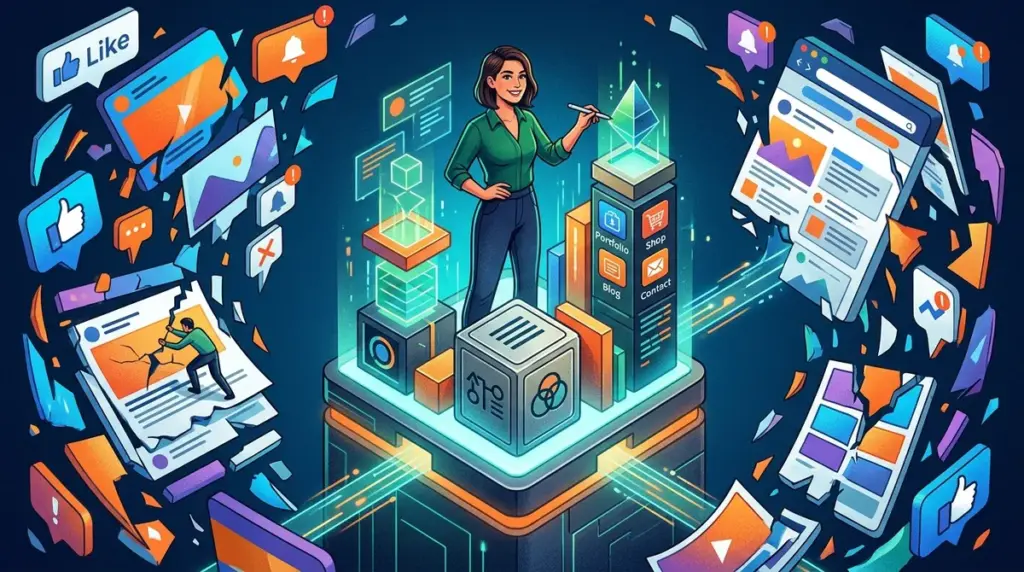
Digital sharecropping occurs when a creator invests the bulk of their intellectual capital into a platform they do not control. When a social network pivots its video strategy or throttles external links to keep users within its "walled garden," the creator’s reach is decimated overnight. A personal website removes this intermediary. By hosting content on a domain you own, you insulate your brand from the capricious nature of feed-based discovery.
Best for: Consultants and agency founders who need a permanent, searchable repository for case studies that won't disappear into a chronological feed.
The value of a standalone site lies in its compounding nature. Social posts have a half-life measured in hours. A well-optimized technical guide or a deep-dive industry analysis on a personal domain can rank for years, generating passive lead flow through organic search. This longevity creates a "moat" around your professional identity that a high-engagement tweet thread simply cannot replicate.
Escaping the Algorithmic Tax
Platforms charge an "algorithmic tax" on every piece of content you produce. To maintain visibility, you must adhere to specific formats—whether that is short-form video or engagement-baiting polls. On your own site, the only constraints are user experience and technical performance. You can deploy long-form interactive data visualizations, custom JavaScript tools, or niche resource libraries that would be impossible to host on a standardized social profile.
First-Party Data and the Privacy Pivot
As third-party cookies phase out and privacy regulations like GDPR and CCPA tighten, the ability to collect first-party data becomes a competitive advantage. Social platforms provide aggregated, anonymized analytics that serve their advertisers, not your business goals. A personal website allows for the implementation of server-side tracking and direct lead capture, giving you a granular view of how your audience interacts with your work.
Key Advantage: Direct ownership of the email list. While a social follower is a platform asset, an email subscriber is a portable business asset. Integrating a newsletter signup directly into your site’s architecture ensures that if a platform vanishes, your direct line to your audience remains intact.
Pro Tip: Do not just mirror your social content on your website. Use your site as the "canonical" source. Publish deep-dives there first, then use social channels as a high-frequency laboratory to test ideas and drive traffic back to your domain. This creates a hub-and-spoke model where the value always accrues to your owned property.
Technical SEO as a Career Sandbox
For marketers and SEOs, a personal website is the ultimate laboratory. It is where you can experiment with Schema markup, test the impact of Core Web Vitals optimizations, and trial new CMS architectures like headless WordPress or Ghost without risking a client’s production environment. It serves as a living portfolio of your technical competence.
- Custom Schema Implementation: Use Person and Article schema to build your Knowledge Graph presence, making you more "understandable" to LLMs and search engines.
- Performance Control: Optimize for sub-second load times to demonstrate mastery over modern web standards.
- Conversion Rate Optimization (CRO): Run A/B tests on landing pages to refine your ability to move users through a funnel.
- Backlink Equity: Every guest post or podcast appearance should point back to your domain, building its authority over time.
The Shift Toward LLM Optimization
As AI-driven search engines like Perplexity and Search Generative Experience (SGE) become mainstream, the structure of your data matters more than ever. Social media profiles provide limited structured data. A personal site allows you to define exactly who you are and what you know through clear site architecture and semantic HTML. This makes it easier for AI models to crawl, index, and cite you as an authoritative source in your specific niche.
Architectural Freedom and Brand Differentiation
The "LinkedIn beige" aesthetic and the standardized grid of Instagram force every professional into the same visual box. A personal website is a design differentiator. Whether you use a minimalist static site generator like Hugo or a highly interactive Webflow build, the design communicates your brand values before a single word is read. This is particularly vital for creators in the technology and startup space, where technical sophistication is a prerequisite for trust.
Best for: Developers and designers who need to showcase bespoke functionality, custom API integrations, or high-performance frontend work that templates cannot support.
Executing a High-Impact Site Strategy
To maximize the utility of a personal site, focus on these three pillars of digital architecture:
1. The Content Moat: Produce "evergreen" assets—calculators, templates, or white papers—that people bookmark and return to. This builds recurring direct traffic that is independent of search or social trends.
2. Technical Integrity: Ensure your site passes all Core Web Vitals. In an era of bloated, ad-heavy web pages, a fast, clean, and accessible site is a massive user experience win.
3. Interconnected Ecosystem: Use your site as the central node. Your social profiles should serve as discovery layers, but the "conversion" (whether that’s a newsletter sign-up, a consultation booking, or a software download) must happen on your domain.
Future-Proofing Your Digital Presence
The era of "set it and forget it" social media strategy is over. As platforms become more fragmented and expensive, the ROI of a personal website continues to climb. Start by securing a clean, professional domain—preferably your name or a focused brand—and deploy a lightweight CMS. Prioritize a mobile-first design and a clear call to action. By shifting your best work from rented platforms to owned infrastructure, you transition from being a guest in someone else’s ecosystem to being the architect of your own. The goal is not to abandon social media, but to use it as a tool for building an asset that you—and only you—control.
Frequently Asked Questions
Should I use a static site generator or a traditional CMS?
If you value speed and security and have basic technical skills, a static site generator (SSG) like Hugo or Jekyll is superior. For those who need ease of use and a robust plugin ecosystem, Ghost or a lightweight WordPress build is more practical. The key is ensuring the platform allows for full control over SEO metadata and data export.
How often do I need to update my personal website?
Quality outweighs frequency. Unlike social media, which requires daily posting to stay relevant, a personal site benefits from high-quality, long-form updates once or twice a month. Focus on "pillar" content that answers specific industry questions or solves technical problems.
Is it worth the cost if I already have a large LinkedIn following?
Yes. A large following on a third-party platform is a liability if you don't have a way to reach those people off-platform. A website allows you to convert that "rented" audience into a "owned" audience via email lists and direct traffic, protecting you from platform bans or algorithm shifts.
How does a personal site help with AI search visibility?
Personal websites allow you to use JSON-LD Schema and clear, hierarchical H-tags that help AI crawlers understand the context of your expertise. By providing a clean, authoritative source of truth, you increase the likelihood of being cited by AI search engines as a primary reference.