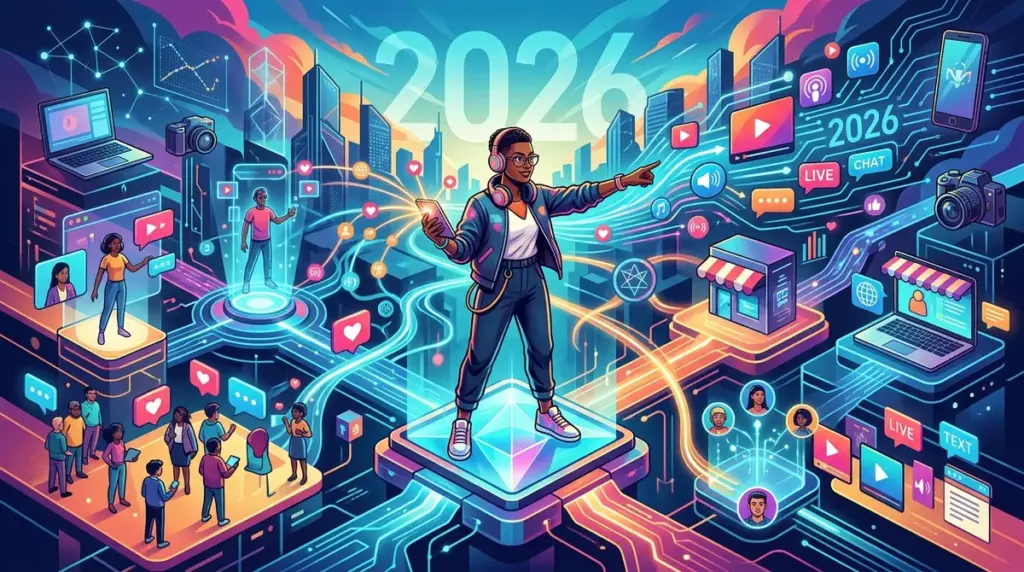
By 2026, the traditional concept of a "website" as a standalone destination has collapsed. A strong online presence is no longer defined by a high volume of organic traffic hitting a homepage; it is defined by Entity Authority—the ability of a brand to exist as a verified, trusted data point across a fragmented ecosystem of LLMs, social search engines, and zero-click interfaces. For CMOs and agency leads, the investment shift moves from "content production" to "infrastructure and attribution." If your brand cannot be cited by a generative AI agent or discovered via a 15-second vertical video, it effectively does not exist in the 2026 marketplace. This distinction between being known and being trusted online is paramount for establishing genuine Entity Authority in 2026.
The Shift from Keywords to Entity Mapping
Search engines have moved fully away from matching strings of text to understanding the relationship between entities. In 2026, a strong presence requires a robust Knowledge Graph. This means your brand, its founders, its products, and its core intellectual property must be clearly defined in structured data that machines can parse without ambiguity.
Schema as the New API
Standard SEO used to treat Schema markup as a "nice to have" for rich snippets. Now, it is the primary language of discovery. To maintain visibility, sites must implement advanced Organization, Product, and SameAs schema to link disparate profiles across the web. This creates a "digital twin" of the business that AI crawlers use to verify facts. Without this, your brand risks being hallucinated or ignored by AI-driven search results that prioritize verified nodes over unoptimized blog posts.
Fragmented Search and the Rise of Vertical Discovery
Google is no longer the sole arbiter of intent. A strong 2026 presence acknowledges that search is verticalized. Users search for products on TikTok, professional services on LinkedIn, and technical solutions via Perplexity or ChatGPT.
Best for High-Growth Startups: A "Social-First, Site-Second" strategy. This involves using short-form video to capture top-of-funnel awareness, while the website serves as a high-intent conversion engine and data repository. The goal is to dominate the "Search Everywhere" model, ensuring that a brand appears in the top three results regardless of the platform’s specific algorithm.
Warning: Over-reliance on AI-generated content without a "Human-in-the-Loop" verification process will lead to a rapid decay in E-E-A-T (Experience, Expertise, Authoritativeness, Trustworthiness). Search engines in 2026 are aggressively de-indexing sites that lack original data, proprietary imagery, or verifiable expert citations.
Technical Performance: Interaction to Next Paint (INP)
Core Web Vitals have evolved. By 2026, "Interaction to Next Paint" (INP) is the dominant metric for user experience. It measures the latency of every user interaction, not just the initial load. A strong online presence requires a headless or highly optimized frontend architecture that feels instantaneous. If a user clicks a filter or a mobile menu and experiences a delay of more than 200 milliseconds, the bounce rate spike is now a direct ranking signal for both traditional search and AI referral engines.
- Edge Computing: Moving logic closer to the user to reduce latency to sub-50ms.
- Semantic HTML: Ensuring that content hierarchy is readable by non-visual agents (AI scrapers).
- Zero-Javascript Options: Providing lightweight versions of pages for low-bandwidth AI crawling.
- Vector Database Integration: Allowing site search to function with the same conversational nuance as ChatGPT.
- Privacy-First Analytics: Shifting to server-side tracking to bypass the total death of third-party cookies.
Owned Audience Infrastructure and Defensive Moats
As organic reach on third-party platforms continues to decline due to "pay-to-play" algorithms, a strong presence is defined by what you own. This is the "Defensive Moat" strategy. Successful brands in 2026 have moved their most valuable interactions off public feeds and into owned ecosystems.
The Resurgence of Direct-to-Consumer Data
A strong presence now includes a robust newsletter, a private community (Discord or Slack), or a proprietary app. This allows for "Zero-Party Data" collection—information users intentionally share with you. In an era where AI can scrape and replicate your public content, your private data and direct relationships are the only assets that cannot be commoditized. High-performing agencies are now prioritizing "Email Capture Rate" over "Page Views" as the primary KPI for digital health.
Information Gain: The New Content Standard
Regurgitating existing information is a recipe for invisibility. To rank and be cited by AI in 2026, content must provide "Information Gain"—new data, unique perspectives, or proprietary research that does not exist elsewhere on the web.
Best for B2B Publishers: Investing in original whitepapers, case studies with raw data, and "behind-the-scenes" technical deep dives. AI models are trained to summarize the consensus; they only cite the outliers who provide the source data. If your content can be summarized by an AI without the AI needing to link to you, your content has failed the Information Gain test.
Building Your 2026 Roadmap
To audit your current standing, move away from vanity metrics like "Total Backlinks" and look at "Brand Mentions in AI Responses." Audit your technical stack for INP compliance and ensure your Schema is not just present, but comprehensive. Transition your content team from "writers" to "subject matter experts" who can produce the original research required to satisfy Information Gain requirements. Finally, diversify your discovery channels to include vertical video and conversational search, ensuring your brand is an omnipresent entity rather than a static URL.
Frequently Asked Questions
What is the most important SEO metric in 2026?
Entity Authority and Information Gain. Search engines now prioritize how often your brand is cited as a primary source of unique data rather than just how many keywords you rank for.
How does AI search change my content strategy?
You must produce content that provides "Information Gain." If an AI can answer a user's question using its training data alone, it won't click through to your site. You must provide the data, charts, or expert opinions that the AI needs to cite.
Is a website still necessary in 2026?
Yes, but its role has changed. It is no longer just a brochure; it is a verified data source for AI agents and a conversion hub for your owned audience. It must be technically flawless, specifically regarding Interaction to Next Paint (INP) metrics.
Should I stop focusing on Google?
No, but you should stop focusing exclusively on Google. A strong presence requires a multi-modal approach where you are discoverable on TikTok, YouTube, and AI platforms like Perplexity, as these are where the next generation of users starts their search journey.