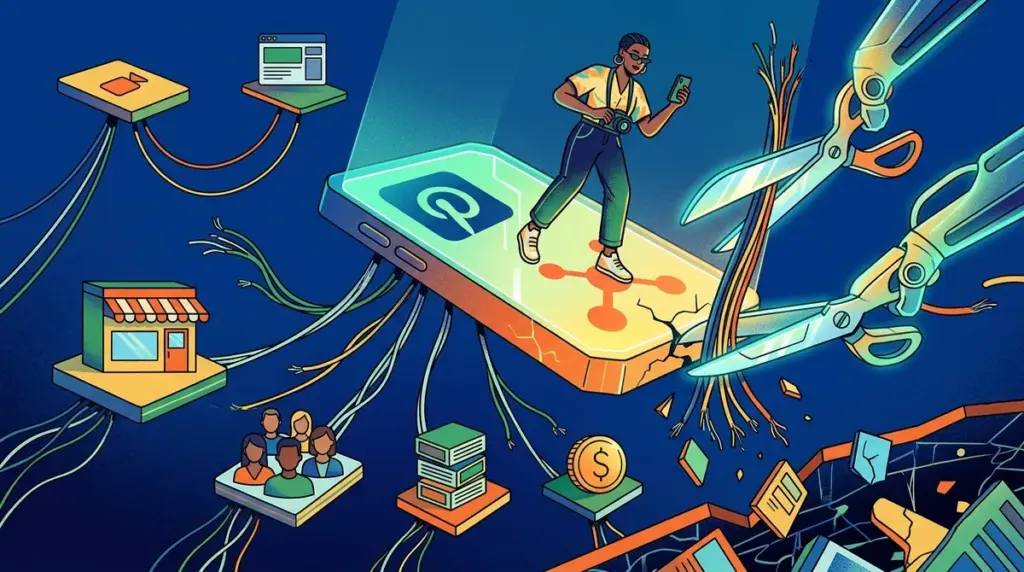
Building a business on top of a third-party platform is a Faustian bargain that every modern founder eventually faces. In the early stages, the trade-off is irresistible: you exchange long-term sovereignty for immediate distribution. Whether it is a DTC brand scaling on Meta ads, a creator building a paid following on Substack, or a SaaS company relying on the Salesforce AppExchange, the platform provides the infrastructure and the audience that would otherwise take years to cultivate. However, this convenience carries a hidden liability known as "platform risk." When the platform’s incentives shift—whether through algorithm updates, fee hikes, or direct competition—the businesses built on top of them often find themselves facing an existential crisis with zero recourse.
The Lifecycle of Platform Dependence
Platforms follow a predictable trajectory often described as "enshittification." Initially, they are generous with organic reach and low fees to attract high-quality creators and developers. Once the network effect is locked in and the platform needs to satisfy shareholders, they pivot to extracting value. This transition transforms a partner into a predator. For a business, this shift manifests as a sudden drop in organic visibility or a "pay-to-play" mandate where you must buy back the access to the audience you already worked to acquire. This transition transforms a partner into a predator, as platforms follow a predictable trajectory.
Best for: Risk assessment and long-term strategic planning for digital-first companies.
The Algorithm Arbitrage Trap
Many startups confuse "platform arbitrage" with a sustainable business model. If your customer acquisition cost (CAC) is only viable because of a specific loophole in an algorithm or a temporary period of underpriced attention, you do not have a business; you have a trade. When Google introduces a "zero-click" search result that answers a query directly on the SERP, or when TikTok throttles external links to keep users within its ecosystem, businesses that haven't diversified their traffic sources see their Lifetime Value (LTV) to CAC ratios collapse overnight.
Quantifying Your Single-Point-of-Failure Risk
To move beyond vague concerns, you must audit your operational dependencies. A business is over-leveraged if it meets any of the following criteria:
- Over 60% of total traffic or revenue originates from a single domain or app.
- The primary customer communication channel (e.g., Instagram DMs) is owned by a third party that can revoke access without notice.
- The product functionality relies on a specific API that restricts data portability or limits competitive features.
- Customer data is siloed within a platform, preventing you from building a direct-to-consumer relationship via email or SMS.
Warning: Never mistake a "verified" account or a "partnership" status for a legal guarantee of service. Platforms routinely deprecate APIs and change Terms of Service with 30-day notices that can invalidate your entire technical stack or revenue model.
Strategies for Audience Sovereignty
The goal is not to abandon platforms—which remain the most efficient discovery engines in existence—but to use them as top-of-funnel "rented" space that feeds into "owned" assets. This requires a shift from platform-native growth to infrastructure-independent growth.
The First-Party Data Pivot
Every interaction on a third-party platform should be treated as a lead generation opportunity for your own database. This means prioritizing email sign-ups, SMS opt-ins, and community memberships over "likes" or "followers." A follower on X (formerly Twitter) is a vanity metric that the platform controls; an email address is a portable asset that you can take to any service provider. Businesses that survived the 2018 Facebook News Feed purge were those that had already migrated their most engaged users to private newsletters and direct-access portals.
Diversifying the Technical Stack
Relying on a single cloud provider or a single marketplace for distribution is a technical bottleneck. For e-commerce, this might mean maintaining a Shopify store while also selling on Amazon, rather than letting Amazon handle 100% of the logistics and customer data. For software companies, it means building with a "headless" architecture where the front-end experience is decoupled from the back-end platform, allowing you to swap out providers if a platform becomes too expensive or restrictive.
Infrastructure Resilience and Margin Protection
Platform dependency eventually erodes margins. As platforms increase their "take rate"—the percentage they keep from every transaction—the business on top must either raise prices or accept lower profits. To protect your margins, you must develop "exit velocity" from the platform. This involves building a brand that customers search for by name, rather than discovering through an ad or a recommendation engine. When a customer types your URL directly into their browser, you have successfully mitigated platform risk.
A Framework for Platform Independence
Reducing dependency is a staged process. Start by mapping your "revenue-at-risk" for every major platform you use. If a 20% increase in ad costs or a 50% drop in organic reach would make your business unprofitable, you are in the danger zone. Move toward a multi-channel approach where no single source accounts for more than 30% of your lead flow. Invest in SEO for long-term organic stability, but treat it as one pillar among many, including direct mail, referral programs, and proprietary content hubs. The ultimate form of security is a direct relationship with your customer that no algorithm can intercept. Reducing dependency is key because platform risk is a bigger problem than many realize.
Frequently Asked Questions
How do I know if I am too dependent on one platform?
Perform a "blackout test" in your projections. If that platform disappeared tomorrow, would your business survive for more than 90 days? If the answer is no, your dependency is a critical vulnerability that needs immediate diversification.
Is it possible to scale without using major platforms?
It is significantly harder and slower, but possible through "dark social," word-of-mouth, and niche community building. Most successful modern businesses use platforms for initial velocity but aggressively pivot to owned channels once they hit a certain revenue threshold.
What is the most portable asset a business can own?
A clean, opted-in email list and a registered trademark. These allow you to move your audience and your brand identity across different hosting providers and marketplaces without losing the equity you have built.
Should I avoid platform-exclusive features?
Only use them if they provide a massive, measurable ROI that justifies the "lock-in" risk. Always have a "Plan B" for how you would deliver that same value if the exclusive feature were removed or moved behind a paywall.