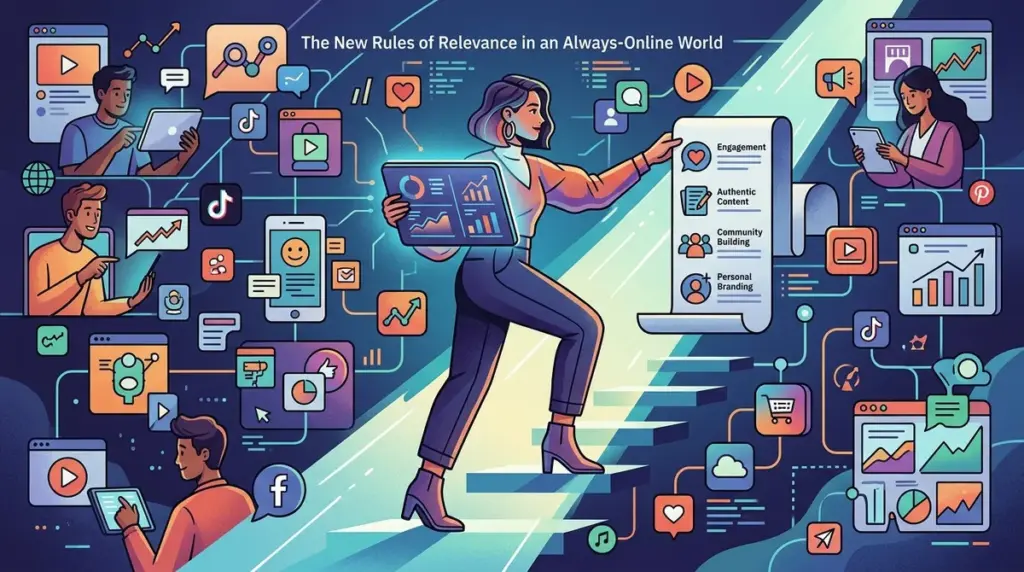
The traditional marketing funnel is collapsing into a single, continuous point of interaction. In an environment where the average user toggles between six different social platforms and a dozen browser tabs, "relevance" is no longer a static ranking factor—it is a fleeting window of utility. For SEO professionals and brand owners, the challenge has shifted from capturing a specific search term to occupying a specific moment of need. To stay visible, content must move beyond being "correct" and start being indispensable.
The Shift from Keyword Density to Entity Mapping
Search engines have largely moved past simple string matching. We are now in the era of entity-based indexing, where Google and other discovery engines analyze the relationship between concepts, people, and brands. Relevance today is defined by how well your content fits into a knowledge graph. If you are writing about "decentralized finance," the algorithm expects to see high-density associations with specific protocols, regulatory bodies, and technical hurdles. If those associations are missing, the content is deemed shallow, regardless of how many times the primary keyword appears.
Best for: Technical SEOs and content strategists focused on high-competition niches like Fintech, SaaS, and Health.
This shift requires a move toward "topic clusters" that prioritize depth over breadth. Instead of targeting 50 disparate keywords, successful agencies are building deep-dive hubs that answer every tangential question a user might have. This signals to search engines that your domain is an authority on the entity itself, not just a collector of traffic for a specific phrase.
The Information Gain Mandate
With the explosion of LLM-generated content, the internet is facing a "sea of sameness." When every blog post on the first page of Google says the same five things, the search engine looks for "Information Gain"—a metric that rewards content for providing new, unique information not found elsewhere in the search results. This is a defensive move by search engines to prevent their results from becoming a feedback loop of AI-generated summaries.
To achieve high relevance scores, you must include elements that an LLM cannot hallucinate or scrape from existing top-10 lists:
- Proprietary data sets or internal case studies.
- Direct quotes from subject matter experts (SMEs) that offer contrarian views.
- High-resolution, original imagery or custom-coded interactive tools.
- Specific "failure stories" that provide practical warnings to the reader.
Warning: Publishing generic, AI-assisted content without significant human editing or the addition of unique data points is a fast track to the "Helpful Content" graveyard. If your article can be perfectly summarized by a 10-word prompt, it has zero long-term SEO value.
Optimizing for the Multi-Platform Discovery Journey
The "always-online" world means that discovery doesn't start and end on a search results page. A user might see a trend on TikTok, search for a deep dive on Reddit, and then look for a professional service on Google. Relevance in this context means maintaining a consistent presence across these touchpoints. This is often referred to as "Surround Sound SEO."
The Rise of Reddit and Community-Led Search
Google’s recent updates have heavily favored forum content because users crave the "human-to-human" verification found on platforms like Reddit and Quora. For brands, relevance now involves active participation in these communities. It is no longer enough to own the top spot for a "best of" list; you need to be the brand that real people are recommending in the comments sections. This requires a shift from broadcast marketing to community engagement.
Video as a Primary Search Format
Short-form video is no longer just for entertainment; it is a primary search engine for Gen Z and increasingly for Millennials. If your brand is not translating its core expertise into 60-second vertical videos, you are invisible to a massive segment of the market. These videos must be optimized with closed captions and keyword-rich descriptions, as search engines are getting better at indexing the actual audio and text within video files.
Technical Integrity and the INP Standard
Relevance is also a function of performance. A user who clicks a link only to wait four seconds for a page to load will immediately bounce, signaling to the search engine that the result was irrelevant to their needs. With the introduction of Interaction to Next Paint (INP) as a Core Web Vital, the bar for technical excellence has been raised. It is no longer just about how fast the page loads, but how responsive it feels once the user starts interacting with it.
High-performance sites utilize server-side rendering (SSR) for critical content and defer non-essential JavaScript to ensure that the user’s first click—whether it’s a menu toggle or a sign-up button—is processed instantly. In the mobile-first world, technical friction is the fastest way to lose relevance.
Operationalizing Relevance for 2024 and Beyond
To maintain a competitive edge, marketing teams must move away from monthly keyword reporting and toward a more holistic "share of search" model. This involves auditing your digital footprint to ensure that your brand appears wherever your customers are asking questions. Start by identifying the "Zero-Click" opportunities in your niche—those snippets and AI-generated answers where you can provide value even if the user doesn't click through to your site. This builds brand salience, which is the ultimate form of relevance.
Focus on building a "moat" around your content through original research and high-production value. In a world where content is cheap and attention is expensive, the only way to stay relevant is to be the most reliable, fastest, and most unique source of information in your vertical.
Frequently Asked Questions
How do I measure "Information Gain" for my existing content?
Compare your content against the top three ranking results for your target keyword. If you are not providing a data point, a visual, or a perspective that is absent from those three pages, your Information Gain score is likely low. Audit your posts to add original quotes or proprietary statistics to differentiate your page.
Does social media activity directly impact my search engine rankings?
While social signals (likes and shares) are not direct ranking factors, the traffic and brand searches they generate are. High engagement on social platforms leads to an increase in branded searches (e.g., people searching for your brand name specifically), which is a powerful signal of authority and relevance to search engines.
What is the most important technical metric to watch this year?
Interaction to Next Paint (INP). It replaced First Input Delay (FID) as a Core Web Vital and measures the latency of all interactions on a page. Sites that feel "laggy" on mobile devices will see a decline in rankings as Google prioritizes user experience and responsiveness.
Should I still focus on long-form content?
Yes, but only if the topic demands it. Long-form content for the sake of word count is dead. However, "comprehensive" content that serves as a definitive resource for a complex topic remains highly effective for building topical authority and earning backlinks.