
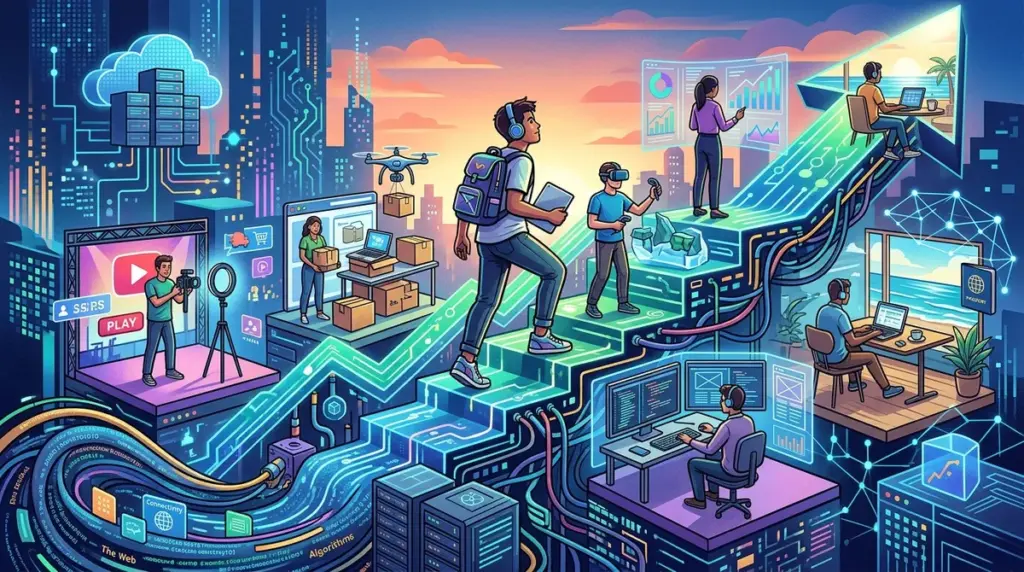
The traditional career ladder—a linear ascent within a single organization or industry—has been replaced by a decentralized network of high-leverage opportunities. For agencies and digital entrepreneurs, this shift represents more than just a change in job titles; it is a fundamental restructuring of how value is created and captured. The internet did not just digitize existing roles; it built the infrastructure for permissionless career paths that bypass traditional gatekeepers like HR departments and university credentials. Today, a professional’s market value is dictated by their digital footprint, their ability to navigate platform algorithms, and their capacity to turn niche expertise into scalable intellectual property. This fundamental restructuring demonstrates how the internet reshaped careers by enabling decentralized opportunities and bypassing traditional gatekeepers.
The Rise of the Fractional Executive and the Micro-Agency Model
One of the most significant shifts in the digital economy is the move toward fractional leadership. High-growth startups and established mid-market companies no longer require full-time, in-house executives for every function. Instead, they are hiring "Fractional CMOs" or "Fractional SEO Leads" who provide high-level strategy across three to five different companies simultaneously. This model allows the professional to diversify their income while giving the client access to veteran talent at a fraction of the cost of a full-time C-suite salary.
This has birthed the "Micro-Agency," a lean operation typically run by one or two principals who utilize a global network of specialized contractors. Unlike traditional agencies with heavy overhead and bloated account management teams, micro-agencies focus on high-margin, specialized deliverables such as programmatic SEO, conversion rate optimization (CRO), or specialized paid media for B2B SaaS. The differentiator here is not headcount, but the proprietary "stack" of tools and workflows the agency uses to drive measurable ROI.
The Creator Economy as a B2B Powerhouse
While mainstream media often focuses on lifestyle influencers, the real commercial shift is happening in the B2B creator space. Professionals are now building careers as "Authority Brands" on platforms like LinkedIn and X (formerly Twitter). By consistently publishing high-signal content, these individuals attract inbound leads that would previously have required a massive outbound sales team. This career path is built on the principle of "Content as Code"—the idea that a well-written guide or a viral thread works for you 24/7, generating trust and authority while you sleep.
Best for: Consultants and niche specialists who want to decouple their income from their time by selling digital products, workshops, or high-ticket advisory services alongside their primary work.
Platform-Specific Arbitrage and Ecosystem Careers
Entire career paths now exist solely within the ecosystems of major tech platforms. These roles didn't exist fifteen years ago because the underlying infrastructure wasn't mature enough to support them. We are seeing the professionalization of roles that are essentially "arbitrageurs" of platform traffic and data.
- Marketplace SEOs: Professionals who specialize exclusively in optimizing for Amazon’s A9 algorithm, the App Store, or Etsy, rather than general web search.
- Media Buyers for Emerging Channels: Experts who master the unit economics of TikTok Ads or Connected TV (CTV) before the rest of the market catches up.
- Prompt Engineers and AI Ops: A new class of technical specialists who bridge the gap between LLM capabilities and business workflows, ensuring that AI integration actually results in efficiency rather than just novelty.
- Community Architects: Strategists who build and manage private, paid communities (on platforms like Circle or Skool) that serve as the primary retention engine for a brand.
Pro Tip: Avoid "platform dependency" by ensuring your primary career asset—your audience or client list—is portable. Use platforms for discovery, but move your core value to owned channels like email lists or proprietary software tools to mitigate the risk of sudden algorithm shifts.
The Technical SEO and Data Storytelling Convergence
The gap between marketing and engineering has narrowed. The modern SEO professional is often part data scientist and part developer. Careers are being built around "Technical Content Engineering," where the goal is to use Python or Javascript to automate data collection and then turn that data into unique, linkable assets. This is no longer about writing 800-word blog posts; it is about building interactive calculators, data dashboards, and automated reporting tools that provide utility to the end user.
For agencies, this means hiring for "T-shaped" skills. A strategist needs to understand how a headless CMS functions and how API integrations affect site performance. The commercial value lies in the ability to translate complex technical constraints into business outcomes, a skill set that commands significantly higher retainers than standard content production.
Scaling Your Digital Career Footprint
To capitalize on these new paths, professionals must move away from the "resume" mindset and toward a "portfolio of assets" mindset. This involves building a personal distribution channel, mastering a specific vertical, and developing a stack of repeatable processes. The internet rewards those who can prove their results in public. Whether you are an independent consultant or a high-level agency lead, your ability to document your process and share your wins serves as a permanent, searchable record of your competence. Professionals can achieve greater career security by building a personal distribution channel and proving their value publicly.
The most successful modern careers are those that leverage the internet’s zero-marginal-cost distribution. Once you have built a system or a piece of content, the cost of sharing it with the second person is effectively zero. This scalability is what allows a solo operator to out-earn a traditional mid-sized firm.
Frequently Asked Questions
How do I transition from a traditional role to a fractional one?
Start by identifying a high-value problem you have solved repeatedly. Package this solution into a 90-day "sprint" or advisory framework. Reach out to companies that are too small to hire a full-time executive but large enough to have the budget for a specialized consultant to fix that specific problem.
Is the creator economy too saturated for new professionals?
Generalist content is saturated, but hyper-niche expertise is not. The internet allows you to be the "best in the world" at something very specific, such as "SEO for Fintech startups" or "Retention strategy for subscription apps." The narrower your focus, the less competition you face.
What technical skills are most valuable for non-developers?
Understanding how to use "No-Code" tools (like Zapier, Airtable, or Webflow) and basic data analysis (SQL or advanced Excel) are the highest-leverage skills for modern marketers. These allow you to build and automate systems without needing a full engineering team.