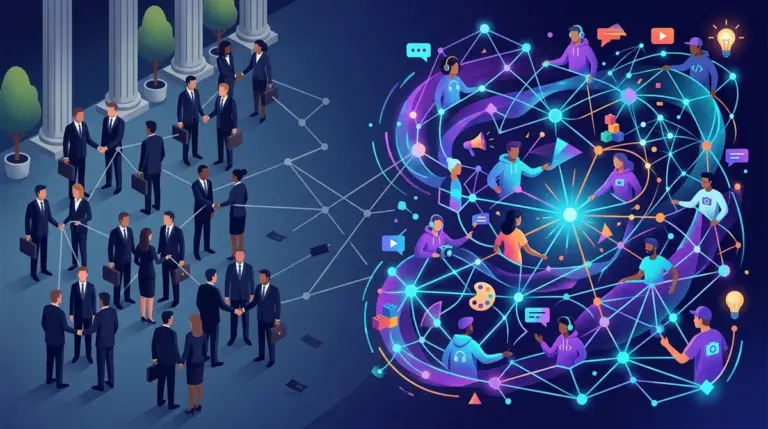
The traditional wall between the person who builds the product and the person who talks about it has collapsed. In the previous era of digital business, a founder built software, a consultant sold expertise by the hour, and a creator produced content for ad revenue. Today, these roles have merged into a single, high-leverage identity: the hybrid operator. This shift isn't about vanity or "personal branding" in the influencer sense; it is a cold-blooded response to the rising cost of customer acquisition (CAC) and the commoditization of software and services.
The Collapse of the Traditional Business Silo
In a saturated market, the technical moat is often shallower than it appears. If you build a SaaS tool, a competitor can replicate your feature set within months. If you offer a consulting service, a thousand other agencies are bidding on the same keywords. The hybrid model solves this by moving the competitive advantage from the "what" to the "who."
The Unit Economics of the Hybrid Model
When a founder operates as a creator, they are essentially running an internal media company that functions as a zero-cost marketing department. For a standard startup, CAC often exceeds the initial contract value, requiring months of retention just to break even. For a creator-founder, the audience is built upfront. By the time a product launches, the cost to acquire the first thousand users is effectively the time spent writing a newsletter or recording a podcast—assets that also generate their own standalone revenue or authority.
The Creator-Founder: Productizing Personal Distribution
The creator-founder does not just "build in public"; they treat their audience as a research and development lab. This model flips the traditional startup sequence. Instead of building a product and hunting for a market, they aggregate a market and then build the product that the market is already asking for.
Best for: Technical founders who want to avoid the "build it and they will come" trap and solo-entrepreneurs looking for high-margin software plays.
- Distribution-First Development: Using platforms like X, LinkedIn, or niche newsletters to validate features before writing a single line of code.
- Low-Friction Feedback Loops: Direct access to users allows for rapid iteration without the need for expensive third-party user testing.
- Community-Led Growth: Early adopters feel a sense of ownership in the product’s success, turning customers into vocal advocates.
Pro Tip: Do not mistake "building in public" for a diary. Every post should either solve a specific problem for your target user or demonstrate your unique methodology. If your content doesn't provide utility, it isn't marketing; it's noise.
The Consultant-Creator: Scaling Expertise Beyond the Hour
Consultants are traditionally trapped by the "time-for-money" trap. To grow, they must hire more people, which increases overhead and decreases agility. The consultant-creator uses content to "productize" their brain. By documenting their frameworks and sharing their results openly, they move from being a commodity service provider to an industry authority.
This transition usually follows a specific path:
1. High-ticket 1:1 consulting: Establishing the methodology and gathering real-world data.
2. Content creation: Distilling those methods into essays, videos, or templates.
3. Productized services/Digital products: Selling the methodology as a course, a community, or a fixed-price "sprint" that doesn't require the consultant’s constant presence.
The Infrastructure of the Multi-Hyphenate
Blending these roles requires a specific tech stack that prioritizes automation and "owned" distribution. Relying solely on social media algorithms is a risk that hybrid operators cannot afford. The goal is to move "rented" attention from social platforms into "owned" channels like email lists or private communities.
The modern hybrid stack typically includes:
- A Content Engine: Tools like Ghost or Beehiiv for newsletters that allow for tiered memberships and direct monetization.
- Personal CRM: Systems to track relationships with high-value peers and potential customers, moving beyond simple follower counts.
- Asynchronous Communication: Using video messaging or dedicated community platforms to manage client or fan interactions without constant live meetings.
Operationalizing the Hybrid Identity
The primary challenge of this model is context switching. A founder needs to focus on product stability, while a creator needs to focus on creative output. Successful hybrids manage this by creating "content flywheels"—where the work they do for their business automatically generates the content for their audience.
For example, a consultant solving a complex SEO problem for a client can strip the sensitive data and turn the solution into a case study. That case study attracts the next client and provides the foundation for a future software feature. The work is the content, and the content is the work.
Strategic Moves for the Next 12 Months
To successfully merge these roles, you must stop viewing content as a distraction from "real work." In a digital economy, attention is the most liquid asset you can own. Start by identifying the one repeatable framework you use to solve problems and begin documenting it publicly. Shift your focus from "broadcasting" to "utility," ensuring that every piece of content serves as a bridge to your commercial offering. The goal is to create a business where the founder's reputation and the product's utility are mutually reinforcing, creating a moat that is impossible for a traditional, faceless corporation to cross.
Frequently Asked Questions
How do I balance building a product with creating content?
Stop treating them as separate tasks. Use your product development roadmap as your content calendar. Share the bugs you’re fixing, the features you’re debating, and the data you’re seeing. This "document, don't create" approach reduces the creative burden.
Does a founder-led brand make the company harder to sell later?
It can, but only if the product cannot function without the founder's manual intervention. If the brand attracts the users but the product delivers the value, the company remains a valuable asset. Many founders use their personal brand to launch the company and then gradually transition the brand voice to a more corporate identity as it scales.
What is the biggest risk of the hybrid model?
Platform risk. If your entire business depends on a single social media algorithm, you are vulnerable. The hybrid operator must constantly migrate their audience to an email list or a platform they control to ensure long-term stability.