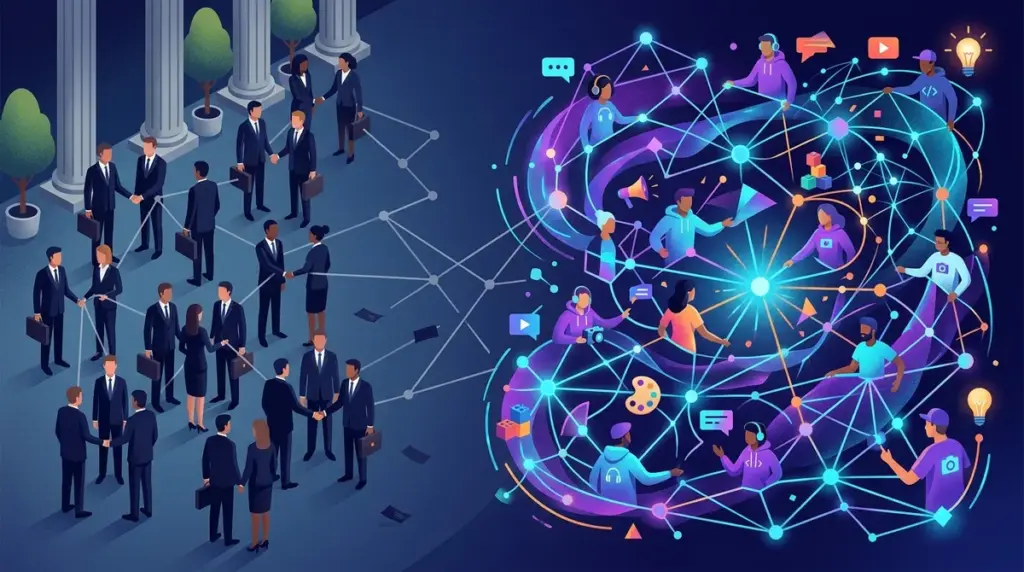
Traditional networking is a high-latency, low-yield activity. For most SEOs and founders, the legacy model of attending mixers or sending cold LinkedIn requests results in a bloated contact list with zero contextual depth. The shift toward niche online communities—private Slacks, Discord servers, and specialized forums—represents a move from transactional discovery to persistent infrastructure. In these environments, social capital is earned through public problem-solving rather than the exchange of a business card.
The Asynchronous Knowledge Liquidity of Private Groups
Traditional networking requires synchronicity. You must be in the same room or on the same Zoom call at the same time to derive value. Online communities operate on asynchronous knowledge liquidity. When a developer shares a fix for a specific Core Web Vitals issue in a private Slack, that information remains indexed, searchable, and valuable long after the initial interaction. For a digital business, this creates a searchable brain that scales without requiring more of the founder's time.
Best for: Reducing the "time-to-answer" for technical roadblocks and vetting vendors through peer-reviewed history rather than sales pitches.
The commercial advantage here is the removal of the gatekeeper. In a traditional setting, you might wait weeks for an introduction to a CMO. In a dedicated community like Superpath or Traffic Think Tank, you are one well-placed comment away from a direct line to decision-makers. The barrier to entry isn't your job title; it is the quality of your contribution.
The Velocity of Trust in Niche Ecosystems
Trust is the most expensive friction point in business. Traditional networking attempts to build trust through proximity and repetition, which is slow. Online communities accelerate trust through "proof of work." When you consistently troubleshoot indexing issues or share data-backed insights in a Discord channel, you are building a public ledger of competence.
The Filter Effect
High-barrier communities (those with membership fees or strict application processes) act as a pre-filter for talent and partnerships. Unlike LinkedIn, where the signal-to-noise ratio is decimated by automated outreach, private communities maintain a high "barrier to entry" that discourages low-value actors. For an agency owner, this means the leads generated within these groups have a significantly higher closing rate because the initial vetting—the "vibe check" and the competence check—has already occurred.
Pro Tip: Do not treat a community like a lead-generation funnel. The moment you pivot to a sales pitch without providing at least three instances of unprompted value, you trigger the "vendor" flag. In high-level communities, being labeled a vendor is a death sentence for organic growth.
Moving from Audience to Ownership
Traditional networking often leaves you at the mercy of platform algorithms. If you build your professional network solely on a social feed, you are renting your reach. Online communities allow for a more fragmented, resilient form of ownership. By participating in multiple niche hubs, you diversify your professional risk. If one platform changes its API or visibility rules, your relationships in a self-hosted Discourse or a private Telegram group remain intact. By diversifying professional risk across these hubs, internet-native careers find resilience against the whims of any single platform.
For creators and startups, these communities serve as a decentralized R&D department. Instead of running expensive market research, you can observe the "pain point" language used by your peers in real-time. This is concrete data that informs product roadmaps and content strategies with more accuracy than any keyword tool.
- Searchable Archives: Instant access to historical solutions for recurring technical debt.
- Vetted Referrals: Access to a "whitelist" of freelancers and agencies proven to deliver in high-stakes environments.
- Real-time Intelligence: Early warnings on algorithm shifts or industry pivots before they hit the mainstream trades.
- Collaborative Leverage: The ability to form "squads" for co-marketing or joint ventures with minimal overhead.
- Reduced Acquisition Costs: Bypassing traditional ad spend by maintaining a presence where your target buyers already seek advice.
The Shift from Broad Reach to Deep Resonance
The obsession with "reach" is a relic of the broadcast era. In the current digital economy, resonance matters more. A traditional network might give you 5,000 "connections" who don't know your middle name. An online community gives you 50 people who will advocate for your brand in closed-door meetings. This "dark social" influence is where the most significant enterprise contracts and high-level hires actually happen.
Best for: Agencies looking to move upstream into enterprise accounts by leveraging peer-to-peer advocacy rather than cold outbound tactics.
Auditing Your Digital Social Capital
To transition from traditional networking to a community-first strategy, you must audit where your time is spent. If you are spending three hours a week at local mixers but zero hours contributing to a technical forum, your professional growth is capped by your physical geography. Start by identifying three "high-signal" communities where your specific expertise is currently underserved. Spend thirty days observing the culture, the common grievances, and the power dynamics before attempting to position yourself as an authority.
The goal is to move from being a "contact" to being a "resource." Contacts are ignored; resources are sought out. In a community-driven world, the person who provides the most clarity wins the most business. This isn't about being "nice"; it is about being indispensable within a specific digital ecosystem.
Frequently Asked Questions
How do I find high-quality communities without wasting time?
Look for "pay-to-play" models or those requiring a manual application. The presence of a moderator and a clear set of community guidelines is usually a sign of a healthy, high-signal environment. Avoid groups that are primarily used for link-sharing or self-promotion.
Is it better to be a member of many groups or deeply involved in one?
Deep involvement in two to three groups yields better ROI than surface-level participation in ten. You need enough presence to be recognized as a consistent value-provider. Spreading yourself too thin leads to "lurker" status, which carries zero social capital.
How do I measure the ROI of the time spent in these communities?
Track three metrics: the number of unsolicited inbound inquiries, the speed at which you can solve a technical problem via community help versus internal research, and the number of high-value introductions made by peers within the group. If these aren't trending upward after 90 days, the community is likely a poor fit for your business goals.