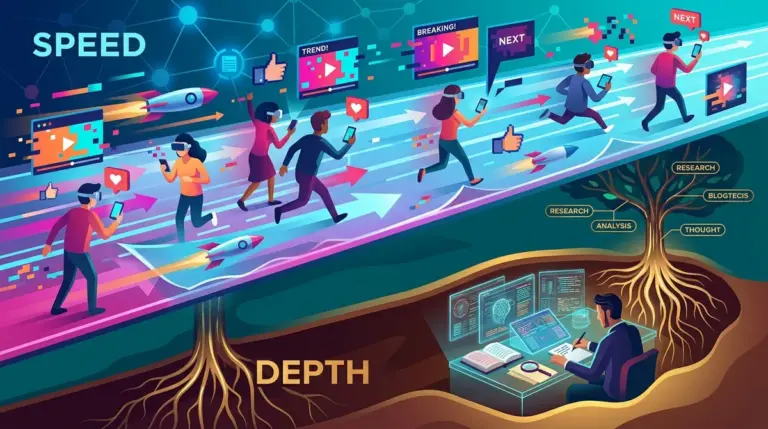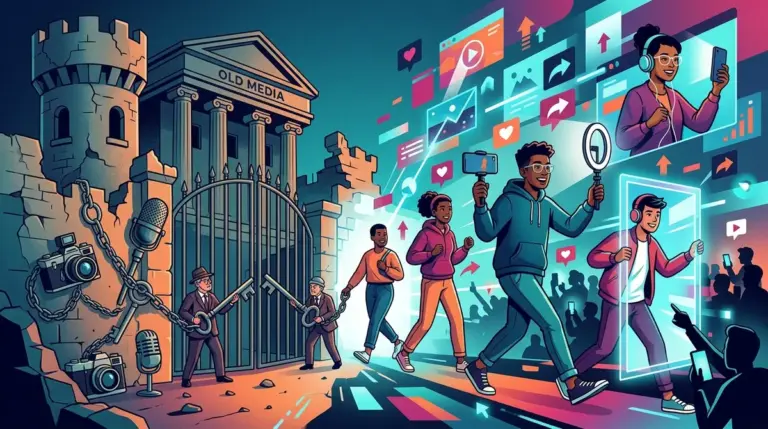

The cost of producing a 1,000-word article has effectively dropped to zero. For media companies, agencies, and digital publishers, this creates a structural crisis: when information is a commodity, the market value of "content" collapses. The only remaining scarcity in the digital economy is authentic human perspective. In a sea of synthetically generated advice, personality has transitioned from a stylistic choice to a hard-coded competitive advantage that protects margins and drives organic growth.
The Devaluation of Commodity Information
For the last decade, SEO was a game of volume and keyword density. If you covered a topic more thoroughly than your competitor, you won. Today, LLMs can synthesize every existing "how-to" guide on the internet in seconds. If your media strategy relies on answering "What is [X]?" or "10 Tips for [Y]," you are competing directly with the training data of the very platforms you rely on for traffic.
Personality acts as a circuit breaker for this automation. It provides the "why" and the "so what" that machines cannot yet simulate with conviction. When a reader recognizes a specific voice—whether it is the sharp skepticism of a tech analyst or the battle-tested pragmatism of a startup founder—they stop scanning for information and start consuming a viewpoint. This shift from "searcher" to "audience member" is the difference between a one-off session and a high-lifetime-value subscriber.
Personality as an Algorithmic Moat
Search engines have pivoted toward Experience, Expertise, Authoritativeness, and Trustworthiness (E-E-A-T). The first "E"—Experience—is the most significant hurdle for AI and the greatest opportunity for human creators. Google’s algorithms increasingly prioritize content that demonstrates first-hand involvement in a topic. A review of a new SaaS tool written by a CTO who actually integrated it into their stack carries more weight than a generic feature list compiled by a freelancer.
The "Experience" Multiplier in Search
When you inject personality, you are essentially providing proof of work. Specificity is the hallmark of human experience. Mentioning a specific bug you encountered during a deployment, a particular conversation with a client, or a contrarian take on a popular industry trend signals to both readers and algorithms that this content cannot be replicated by a model. This reduces your reliance on high-volume, high-competition keywords and allows you to capture "intent-rich" traffic from users looking for expert guidance rather than just definitions.
Pro Tip: Audit your top-performing pages for the "Corporate We." If your content uses generic plural pronouns instead of a specific, named author with a verifiable bio, you are likely leaking trust. Converting a brand-voice article into a signed op-ed can increase click-through rates from search results by up to 15% as users gravitate toward faces over logos.
Building a Creator-Led Media Strategy
Transitioning from a faceless brand to a personality-driven media entity requires a shift in how you recruit and deploy talent. You are no longer looking for "content writers"; you are looking for subject matter experts who can communicate or "ghost-authors" who can extract stories from your internal team.
- Identify Internal Evangelists: Every agency or tech company has a few people who are naturally opinionated. Empower them to write under their own names, even if they aren't professional writers. Raw expertise beats polished mediocrity.
- Develop a Proprietary Lexicon: Create specific terms or frameworks unique to your brand. When you name a concept, you own the conversation around it.
- Prioritize POV Over Neutrality: Neutrality is boring and easily automated. Taking a stand on industry shifts—even a controversial one—builds a loyal core audience.
- Leverage Multi-Channel Presence: Personality doesn't live in a vacuum. A written article should be supported by short-form video or social threads where the same voice is recognizable.
The Economics of Trust and Direct Traffic
The ultimate goal of using personality as a competitive advantage is to decouple your growth from third-party algorithms. When people search for your brand or your lead creators by name, your "customer acquisition cost" for that traffic becomes zero. This is direct traffic—the most valuable metric in media. High direct traffic indicates that you have moved past being a utility and have become a destination.
Best for: B2B agencies and niche publishers who need to justify premium pricing in a crowded market. Personality allows you to sell "the way we think" rather than just "the work we do."
Quantifying the Impact of Voice
While "personality" sounds like a soft metric, its impact is measurable. Compare the performance of your standard "SEO-first" posts against "POV-first" posts. You will typically find that while SEO posts may get more raw hits, POV posts have higher average time-on-page, lower bounce rates, and a significantly higher newsletter conversion rate. In a world where privacy changes are making tracking harder, a direct relationship with an audience via a personality-led newsletter is the only hedge against platform volatility.
Operationalizing Your Unique Perspective
To turn personality into a repeatable asset, you must build a system for capturing and refining it. This isn't about letting everyone post whatever they want; it’s about institutionalizing the "house style" and the "house perspective."
Start by creating a "Counter-Narrative Log." Ask your senior team: What does everyone in our industry believe that we think is wrong? These points of friction are where your most valuable content lives. Use these as the seeds for your editorial calendar. Instead of looking at keyword volume first, look at the "opinion gap" first. If no one is saying what you believe, that is your opening to dominate that niche.
Finally, ensure that your design supports this shift. Author boxes should be prominent, not buried at the bottom. Use real photography of your team, not stock images. The visual language of your site should scream "human" to match the tone of the writing. This cohesion builds the "Brand Affinity" that keeps readers coming back long after they’ve found the answer to their initial search query.
Frequently Asked Questions
How do we maintain a consistent brand voice if multiple personalities are writing?
Establish a core set of "Brand Values" and a "Style Guide" that dictates tone (e.g., "authoritative but not arrogant"). While individual voices will vary, they should all align with the brand’s overarching philosophy. Think of it like a magazine where different columnists have different styles but all fit the publication's identity.
What if our subject matter experts are too busy to write?
Use "Extractors." Assign a writer to interview the expert for 30 minutes. The writer then drafts the piece using the expert’s specific anecdotes, metaphors, and conclusions. This captures the personality without requiring the expert to master the craft of long-form writing.
Is personality-driven content harder to rank in search?
On the contrary, it is becoming easier. Google’s "Helpful Content" updates specifically target "unoriginal content that doesn't add much value." Personality-driven content, by definition, adds unique value and first-hand experience, which are the primary signals the algorithm currently uses to identify high-quality results.
Can personality-led media scale as well as commodity content?
It scales differently. While you may not be able to churn out 100 AI-generated articles a day, the 10 articles you do produce will have a much higher conversion rate and social shareability. You are scaling "depth" and "loyalty" rather than just "width" and "impressions."