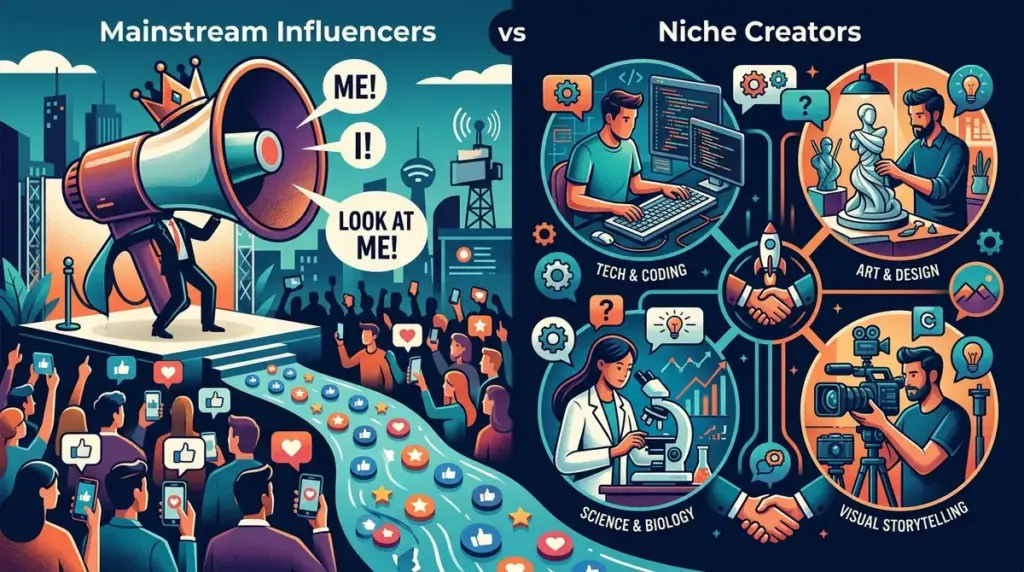
Marketing budgets are currently undergoing a surgical reallocation. The era of the "celebrity" influencer—those with seven-figure follower counts but broad, undefined demographics—is yielding to the niche creator. For digital businesses and agencies, the decision isn't just about reach; it is about the conversion-to-lead ratio. When a mainstream influencer posts a product, they are casting a wide net over a disinterested ocean. When a niche creator speaks, they are addressing a curated room of buyers who have already self-selected into that specific vertical. This shift is driven by a fundamental change in how social algorithms prioritize interest over identity, making the "niche" the new "mainstream" for performance-driven brands.
The Algorithmic Pivot from Social Graphs to Interest Graphs
The primary reason niche creators are outperforming their larger counterparts lies in the architecture of modern discovery engines. Platforms like TikTok and the Instagram Reels tab have moved away from the "social graph"—where you see content from people you follow—to the "interest graph," where you see content based on specific topics you consume.
Mainstream influencers often struggle in this environment because their content is generalist. A creator who posts lifestyle vlogs, travel photos, and generic fashion hauls lacks the semantic density required to trigger the algorithm’s "expert" categorization. Conversely, a niche creator focusing exclusively on mechanical keyboards, SaaS productivity workflows, or sustainable urban gardening provides a clear signal to the platform. The algorithm knows exactly who to serve that content to, resulting in higher organic reach among high-intent users who may not even follow the creator yet.
The Signal-to-Noise Ratio in Broad Markets
In mainstream influencer marketing, "noise" is the percentage of an audience that has zero interest in the sponsored category. If a fitness influencer with 2 million followers promotes a specific project management tool, 95% of that audience is irrelevant to the advertiser. The brand is paying a premium for the 2 million "reach" while only 100,000 people are actually in the target market. A niche creator with 50,000 followers dedicated to "remote work culture" provides a 1:1 signal-to-noise ratio. Every dollar spent is hitting a relevant pair of eyes.
Quantifying the Trust Premium in Vertical Communities
Trust is not a scalable commodity. As a creator’s audience grows, the "parasocial" bond typically weakens, shifting from a peer-to-peer recommendation to a broadcast advertisement. Niche creators maintain what is known as "contextual authority." Because they operate within a specific silo, their endorsement carries the weight of a technical review rather than a paid placement.
Best for: B2B startups and high-ticket D2C brands where the buyer's journey requires significant education and social proof before a conversion occurs.
Data consistently shows that micro-influencers (10k–50k followers) and nano-influencers (1k–10k followers) boast engagement rates significantly higher than those with 500k+ followers. This isn't just about likes; it's about the depth of the comments. In niche communities, the comment section is a forum for technical questions, troubleshooting, and genuine inquiry—all of which move the needle on the sales funnel.
Warning: Beware of "vanity engagement." High like counts on a mainstream influencer's post are often a result of aesthetic appeal or personality cults. For commercial success, look for "intent-based engagement"—comments that ask about pricing, compatibility, or specific use cases.
The Economic Efficiency of Niche Partnerships
From a procurement perspective, niche creators offer a massive advantage in Customer Acquisition Cost (CAC). Mainstream influencers often demand flat fees based on their total follower count, regardless of how many of those followers are active or relevant. Niche creators are often more open to performance-based models, hybrid deals, or lower flat fees that reflect their actual market size.
Working with ten niche creators for $2,000 each often yields a higher ROI than spending $20,000 on a single mid-tier mainstream influencer. This "portfolio approach" allows agencies to:
- Test multiple creative angles across different sub-segments of their target market.
- Identify which specific micro-niches have the highest conversion rates.
- Reduce the risk of a single campaign failure if one creator’s content fails to resonate.
- Build a library of highly specific User Generated Content (UGC) that can be repurposed for paid social ads.
Vetting for Technical Competence Over Aesthetic Appeal
When selecting a niche creator, the vetting process must change. In the mainstream world, marketers look at production quality and "brand fit." In the niche world, you must look for "technical competence." If a creator is representing a fintech product, do they actually understand the mechanics of the platform? If they are promoting a developer tool, can they speak the language of the end-user?
A creator who makes a mistake regarding a technical detail will immediately lose the trust of a niche audience. This is why "creator-led" content in technical fields is so effective—they speak the shorthand of the industry. They know the pain points that a generalist copywriter would miss. They aren't just reading a script; they are solving a problem for their peers.
Key Metrics for Niche Creator Evaluation
Move beyond the standard dashboard metrics. To truly understand a niche creator's value, analyze the following:
- Comment Sentiment Density: Are people asking questions about the product or just complimenting the creator?
- Saves-to-Likes Ratio: High save counts indicate the content is being treated as a resource or a future purchase reference.
- Vertical Saturation: Does the creator dominate a specific hashtag or keyword search within the platform?
- Audience Longevity: Has the creator been talking about this specific topic for years, or are they jumping on a trend?
Operationalizing Niche Creator Partnerships
To capitalize on this trend, brands must stop treating influencer marketing as a "top-of-funnel" awareness play and start treating it as a "mid-to-bottom-funnel" conversion engine. This requires a shift in creative briefs. Instead of asking a creator to "showcase the brand lifestyle," ask them to "demonstrate how this tool solves [Specific Problem X]."
The goal is to integrate the product into the creator's existing utility. If they provide weekly tutorials, the product should be the tool used in the tutorial. If they provide industry news, the product should be the context for that news. By leaning into the creator’s established utility, the brand becomes an essential part of the niche ecosystem rather than an interruption to it. This is how small-scale creators drive large-scale revenue.
Frequently Asked Questions
How do I find niche creators if they don't have a large following?
Don't search by follower count. Search by specific long-tail keywords and hashtags relevant to your industry on TikTok, YouTube, and LinkedIn. Look at who is being cited in industry newsletters or who is active in specialized Discord servers and Subreddits. The most influential niche creators are often "creators' creators"—the people the experts follow.
Is it more work to manage multiple niche creators than one large influencer?
Yes, the administrative overhead is higher. However, the use of creator management platforms and standardized contracts can streamline the process. The trade-off is that you are buying diversified risk and higher precision, which almost always outweighs the convenience of a single large-scale buy.
What is a "good" engagement rate for a niche creator?
While it varies by platform, a niche creator on Instagram or TikTok should ideally see an engagement rate between 3% and 7%. Anything higher suggests a very high degree of community intimacy, while anything lower than 2% may indicate that the audience is no longer aligned with the creator's current content output.
Can niche creators help with SEO?
Absolutely. Niche creators often have high-authority blogs or YouTube channels. A backlink from a relevant niche blog or a well-optimized YouTube description can drive qualified traffic and improve your search rankings for specific, high-intent keywords that mainstream influencers would never rank for.