By 2026, the traditional influencer model has collapsed under the weight of AI-generated content and platform-induced fatigue. For agencies and brand managers, the shift from "macro-reach" to "micro-density" is no longer a strategic choice but a survival requirement. A microcelebrity in this landscape is not defined by a six-figure follower count, but by their ability to command high-intent attention within a specific, often gated, digital ecosystem. Identifying these individuals requires moving past vanity metrics and looking at the infrastructure of their influence.
The Shift from Broad Reach to Vertical Density
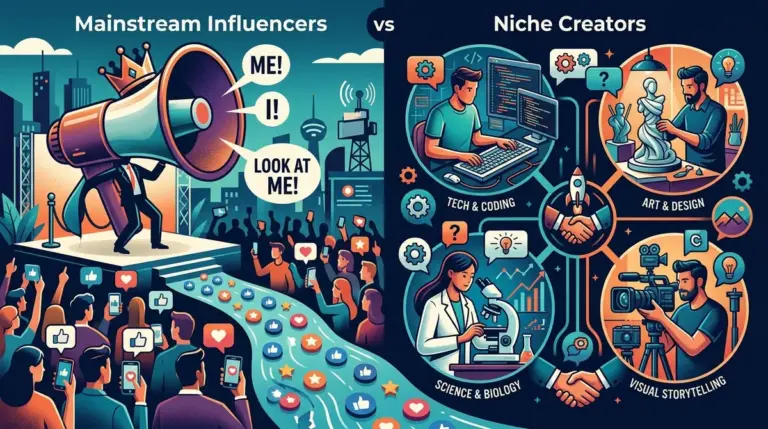
In 2026, the "generalist" influencer is a commodity. As AI tools allow anyone to generate high-fidelity lifestyle content, the market value of "aesthetic" has plummeted to near zero. Microcelebrity now hinges on vertical density—the concentration of a specific audience around a singular, specialized authority. This is the difference between a fitness influencer with a million followers and a "Longevity Biohacker" with 15,000 followers who are all actively purchasing $200 monthly supplement stacks. This specialized authority explains why niche creators often outperform broader, less defined personalities in driving genuine engagement and sales.
The Architecture of Niche Authority
Microcelebrities in 2026 operate like decentralized media companies. They rarely rely on a single algorithm. Instead, they utilize a "hub and spoke" model where social platforms (TikTok, X, Instagram) serve as discovery mechanisms, while the actual value exchange happens in private channels like Discord, Telegram, or specialized newsletter platforms. For a marketer, the value of a microcelebrity is found in their "conversion floor"—the minimum number of sales or actions they can guarantee regardless of algorithmic fluctuations. Understanding this decentralized approach is key to grasping the business model behind modern personalities who prioritize audience ownership.
Technical Markers of the 2026 Microcelebrity
To identify a true microcelebrity, agencies must look for specific behavioral and data-driven signals that indicate genuine community ownership. High-value creators in 2026 exhibit these traits:
- Cross-Platform Migration: The ability to move at least 10% of their audience from a discovery platform (like TikTok) to a high-intent platform (like a paid newsletter or private community) within 30 days of a launch.
- Language Sovereignty: The use of specific jargon, inside jokes, or "lore" that acts as a barrier to entry for outsiders but strengthens the bond with the core audience.
- Proprietary Data: They own their distribution. A microcelebrity without a first-party data strategy (email lists or SMS) is just a tenant on a social platform, not a celebrity.
- Proof of Human (PoH): In an era of deepfakes, microcelebrities often lean into "un-polishable" content—long-form live streams, unedited voice notes, or physical meetups that verify their identity and build parasocial trust that AI cannot replicate.
Warning: Beware of Synthetic Micro-Niches. Many accounts in 2026 use sophisticated AI bot farms to simulate "niche engagement." If an account has high engagement but the comments lack specific, contextual references to previous content or nuanced industry knowledge, you are likely looking at a programmatic facade designed to capture agency spend.
The Commercial CFO Model of Creators
The 2026 microcelebrity functions as their own Chief Financial Officer. They have moved away from the "pay-per-post" model, which they view as a low-margin extraction of their brand equity. Instead, they are looking for "Equity-plus-Performance" (E+P) deals. They want a stake in the companies they promote because they know their endorsement is the primary driver of trust in their vertical.
Best for: Startups in the B2B SaaS, Biotech, and FinTech sectors where the cost per acquisition (CAC) via traditional search ads has become prohibitively expensive. Partnering with a microcelebrity allows these brands to bypass the ad auction and tap into pre-validated trust silos.
Quantifying the "Trust Premium"
When evaluating a partnership, look for the "Trust Premium." This is calculated by comparing the conversion rate of a microcelebrity’s audience against the industry standard for targeted social ads. If the industry average for a specialized software tool is 2%, and the microcelebrity’s referral link converts at 8%, that 4x multiplier is the value you are paying for. It is no longer about "impressions"; it is about the compression of the sales cycle.
Strategies for Scaling Niche Influence
For agencies, the challenge is that microcelebrities do not scale linearly. You cannot simply buy more of them to get the same result. Each one requires a bespoke integration that respects the specific culture of their community. To manage this at scale, brands are increasingly using "Squad Strategies," where they partner with 10-15 microcelebrities who represent different facets of a single subculture.
For example, a sustainable fashion brand might partner with a textile engineer, a circular economy researcher, and a vintage restoration specialist. None of these people are "influencers" in the 2020 sense; they are practitioners who happen to have an audience. This provides the brand with 360-degree credibility that a single celebrity endorsement could never achieve.
Operationalizing Microcelebrity Partnerships
To successfully integrate microcelebrities into a 2026 marketing stack, move away from rigid creative briefs. These individuals know their audience’s tolerance for commercial content better than any brand manager. Provide them with "Value Pillars"—the core truths about the product—and let them translate those truths into the specific vernacular of their community. This approach reduces friction and prevents the "sell-out" narrative that can devalue a micro-niche overnight.
Monitor the "Sentiment Velocity." In small communities, news travels fast. A single poorly executed campaign can trigger a mass exodus or a "cancel" event within a niche. High-touch communication and genuine product alignment are the only ways to mitigate this risk. If the creator doesn't use the product in their daily workflow, their audience will spot the incongruity within minutes.
Frequently Asked Questions
How many followers does a microcelebrity actually need in 2026?
There is no hard floor, but the sweet spot is typically between 5,000 and 50,000. Below 5,000, the sample size is often too small for statistically significant ROI. Above 50,000, the "intimacy" of the community often begins to dilute, and the creator starts to face the same algorithmic pressures as macro-influencers.
What is the most important metric for microcelebrity ROI?
The "Community Retention Rate." This is the percentage of the audience that engages with content over a 6-month period. High churn indicates the creator is relying on viral "hits" rather than building a durable community. Steady, high-depth engagement is the lead indicator of long-term commercial value.
Can an AI be a microcelebrity?
While AI "influencers" exist, they rarely achieve microcelebrity status because they lack the "shared struggle" that defines niche communities. Microcelebrity is built on empathy and shared expertise. While an AI can provide information, it cannot provide the social validation or "proof of life" that human audiences crave in a post-AI digital world.