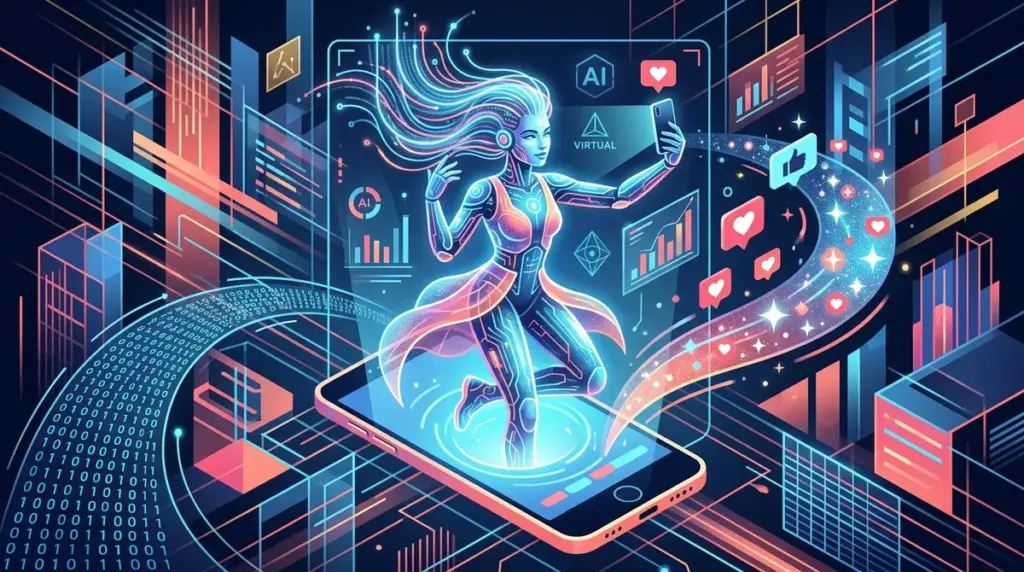
Marketing departments are currently swapping unpredictable human talent for pixel-perfect, programmable avatars that never age, never demand a pay raise, and never trigger a PR crisis. The rise of AI influencers and virtual creators marks a fundamental shift in the creator economy—from individual-led personality brands to corporate-owned, algorithmically optimized assets. For agencies and brand managers, this isn't a futurist experiment; it is a cost-containment strategy and a scalable engagement play. This shift reflects a broader trend in how artificial intelligence is shaping online fame and digital identities.
The Unit Economics of Synthetic Talent
The primary driver behind the adoption of virtual creators is the total control over the production lifecycle. Traditional influencer marketing is plagued by scheduling conflicts, reshoots, and the inherent volatility of human behavior. Virtual creators, such as Lil Miquela or Aitana Lopez, operate on a different financial model. Once the initial character model is developed and the "personality" is defined through a Large Language Model (LLM), the cost of producing new content drops significantly compared to hiring a human crew for a location shoot. This control highlights how AI tools are transforming creator workflows, offering unprecedented efficiency and predictability.
Best for: Brands requiring high-frequency content across multiple time zones without the overhead of travel, wardrobe, and talent management fees.
Virtual creators allow for 24/7 engagement. They can "live stream" in multiple languages simultaneously using voice-cloning technology, responding to comments in real-time without fatigue. This allows a brand to maintain a constant presence in competitive feeds where the algorithm rewards volume and consistency. The ROI is realized through the longevity of the asset; a brand-owned AI influencer is a proprietary piece of intellectual property that appreciates in value as its following grows, rather than a third-party contractor who can take their audience to a competitor at any time.
Scaling Production Without Talent Fees
When a human influencer gains a million followers, their rate card triples. When an AI influencer reaches that same milestone, the cost to generate a post remains virtually the same. This decoupling of reach and cost is the most significant commercial advantage of synthetic media. Agencies are now building "influencer houses" that consist of nothing but server racks and creative directors, bypassing the traditional talent agency model entirely.
The Tech Stack Powering Virtual Creators
Creating a convincing virtual influencer requires more than just a static image. The current industry standard involves a sophisticated pipeline of generative and deterministic tools. To achieve the level of realism required for high-end fashion or tech endorsements, creators use a mix of 3D modeling and AI-driven texture generation.
- Unreal Engine 5 & MetaHuman: Used for creating hyper-realistic 3D skeletons and facial animations that can be ported into video content or interactive live streams.
- Stable Diffusion & LoRA (Low-Rank Adaptation): Essential for maintaining visual consistency. By training a LoRA on a specific character's face and features, creators ensure the AI "remembers" exactly what the influencer looks like across different prompts and environments.
- Midjourney: Frequently used for high-fidelity conceptual art and background environments that provide the "lifestyle" context for the influencer.
- ElevenLabs: The standard for voice synthesis, allowing virtual creators to narrate videos or participate in podcasts with human-like inflection.
The integration of these tools allows for "fast-fashion" content cycles. If a trend emerges on TikTok in the morning, a virtual creator can be rendered into that trend by the afternoon, whereas a human creator might take days to coordinate a shoot and edit the footage.
Warning: The "Uncanny Valley" remains the biggest threat to engagement. If a virtual creator looks 95% human but moves with 80% fluidity, the brain registers it as "creepy," leading to immediate bounce rates. Invest in high-quality rigging over generic AI filters to maintain viewer immersion.
Navigating the Ethics of Disclosure and Trust
As virtual creators become more prevalent, regulatory bodies like the FTC are tightening guidelines. Transparency is no longer optional; it is a brand safety requirement. Labels like #AIInfluencer or "Generated by AI" are becoming mandatory in many jurisdictions to prevent deceptive advertising. However, data suggests that Gen Z and Alpha audiences are less concerned with "authenticity" in the biological sense and more focused on "aesthetic value" and "narrative consistency."
The risk for brands lies in the potential for deepfakes and intellectual property theft. If a brand-owned AI influencer is "hijacked" or parodied using open-source AI tools, the brand must have a robust legal framework to protect its digital likeness. Furthermore, the lack of a "soul" behind the screen means the storytelling must be significantly more compelling to keep users coming back. You aren't selling a person; you are selling a character arc.
The Hybrid Model: Human-AI Synergy
We are seeing the rise of the "Cyborg Creator," where human influencers use AI to create digital twins. This allows the human to focus on high-level strategy and "real-life" appearances while their AI twin handles the volume of daily social media interactions, sponsored posts, and localized content for international markets. This hybrid approach mitigates the risk of audience alienation while still capturing the efficiency gains of synthetic media.
Operationalizing Synthetic Talent
To successfully integrate virtual creators into a marketing strategy, brands must move beyond the novelty phase. Start by defining the specific role the creator plays: is it a customer service avatar, a high-fashion model, or a community mascot? Ownership of the underlying data—the prompts, the trained models, and the 3D assets—is critical. Do not rely on third-party platforms to host the "brain" of your creator; keep your LoRAs and proprietary datasets on-premise or in secure cloud environments to ensure long-term control.
Success metrics for AI influencers should mirror traditional influencer KPIs but with an added focus on "production velocity" and "cost per engagement." If your virtual creator is costing more in GPU hours and prompt engineering than a mid-tier human influencer, your tech stack needs optimization. The goal is to build a high-retention asset that operates with the efficiency of software and the appeal of a celebrity.
Frequently Asked Questions
How much does it cost to launch a virtual influencer?
A basic AI influencer using Stable Diffusion and social media can be launched for under $1,000 in software and compute costs. However, a high-fidelity, hyper-realistic 3D creator capable of video and live streaming typically requires an investment of $20,000 to $50,000 for initial development and rigging.
Are AI influencers legal for commercial endorsements?
Yes, provided they follow FTC guidelines regarding disclosure. The brand must clearly state that the character is virtual. Contracts should also specify that the AI cannot "claim" to have used a physical product (like a skincare cream) in the same way a human would, as this could be considered false advertising.
Do virtual creators actually drive conversions?
Data from platforms like Fanvue and Instagram shows that virtual creators often have higher engagement rates than human influencers, largely due to the novelty factor and the ability to produce visually perfect, "scroll-stopping" content. Conversion rates are highest in the fashion, gaming, and tech sectors where the digital nature of the creator aligns with the product category.
Can an AI influencer be "cancelled"?
While they can't make off-the-cuff remarks at a party, the humans or algorithms managing them can still make mistakes. However, a virtual creator's "history" can be edited or rebooted in a way a human's cannot, providing a unique layer of brand safety and crisis management flexibility.