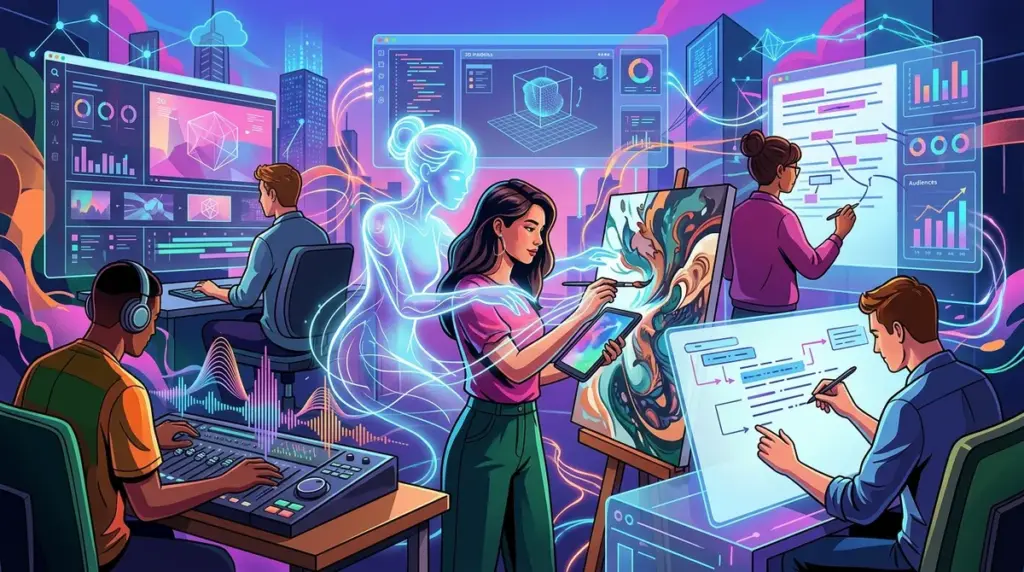
The creator economy is currently undergoing a structural shift in its unit economics. For the last decade, scaling a creative business required a linear increase in headcount: more editors for more video, more writers for more blogs, and more social managers for more platforms. AI has decoupled output from headcount, transforming the creator from a manual laborer into a creative director. This transition isn't about using a chatbot to write a script; it is about leveraging a synthetic workforce to handle the high-latency tasks that previously throttled growth.
The Migration from Timelines to Text-Based Video Editing
Video production has traditionally been the most significant bottleneck for creators. The ratio of filming time to editing time often sits at 1:5. AI-driven non-linear editors are flipping this ratio by treating video as data rather than just a sequence of frames. Tools that utilize Large Language Models (LLMs) to transcribe footage allow creators to edit video by deleting sentences in a text document. This removes the need for manual ripple edits and hunting through hours of raw footage for a specific soundbite.
Best for: YouTube creators and podcasters who need to turn 60 minutes of raw interview footage into a tight 10-minute narrative without hiring a full-time junior editor.
Beyond simple cutting, generative fill and in-painting are solving the "b-roll problem." Creators no longer need to rely on generic stock footage libraries that dilute brand identity. Instead, they can generate specific, contextually relevant visual overlays that match their aesthetic. This level of customization ensures that the visual narrative remains cohesive, even when the creator lacks the budget for a location shoot or a dedicated motion graphics artist.
Synthetic Voice and the End of the Language Barrier
Localization used to be a luxury reserved for top-tier creators like MrBeast, who could afford to hire entire teams of voice actors and channel managers for different regions. AI voice cloning and lip-syncing technology have democratized global reach. High-fidelity voice models can now replicate a creator’s unique cadence and tone in dozens of languages with near-perfect accuracy.
This shift is commercially significant because it allows creators to tap into high-CPM (cost per mille) regions like Germany or the UK without the overhead of a localized production team. The workflow has moved from "record, translate, hire, record again" to "record, translate, and synthesize." This reduces the time-to-market for global content from weeks to minutes.
Warning: Over-reliance on synthetic voices without manual oversight can lead to "semantic drift," where the AI misses cultural nuances or slang, potentially alienating the very audience you are trying to reach. Always have a native speaker audit the first few outputs of a new language model.
Information Gain: The New SEO North Star
As AI-generated content floods the internet, the value of "commodity information" has plummeted to zero. For creators who rely on search traffic, the strategy has shifted from high-volume keyword targeting to "Information Gain." This is a concept where search engines prioritize content that offers unique data, personal experience, or a perspective that doesn't exist in the training data of an LLM.
AI tools are now being used to analyze the "content gap" between what is currently ranking and what the user actually needs. Instead of using AI to write the article, smart creators use it to:
- Analyze the top 10 search results for a specific query to identify missing perspectives.
- Cluster thousands of long-tail keywords into thematic content pillars.
- Generate structured data (Schema) that helps search engines understand the relationship between different pieces of content.
The goal is no longer to be the most comprehensive source—AI can do that—but to be the most original source. Creators are using AI to handle the SEO technicalities so they can focus on original reporting and proprietary data collection.
The Multi-Platform Repurposing Engine
The modern creator business model relies on being everywhere at once. However, the formatting requirements for TikTok, LinkedIn, and YouTube are radically different. AI-driven repurposing tools have moved beyond simple cropping. They now use computer vision to identify the most engaging moments in a long-form video, automatically reframe the shot to keep the subject centered, and generate platform-specific captions.
This "one-to-many" pipeline allows a single piece of pillar content to be fragmented into 20 or 30 micro-assets. For a creator, this means the cost of distribution has effectively dropped to near zero. The competitive advantage now lies in the "hook" and the "story," as the technical barrier to multi-platform dominance has been removed.
Automating the Feedback Loop
Creators are also using AI to process the massive amounts of qualitative data they receive in the form of comments and DMs. Sentiment analysis tools can scan 5,000 comments on a YouTube video and summarize the three most common questions or complaints. This data informs the next piece of content, creating a tighter feedback loop between the creator and the audience. It turns a "guess and check" content strategy into a data-driven operation.
Operationalizing Your AI Content Stack
To remain competitive, creators must move away from the "shiny object" phase of AI and into the operational phase. This means building a documented workflow where AI handles the non-creative tasks. Start by auditing your current production process and identifying the "low-value, high-time" tasks. Usually, this is transcription, initial video rough cuts, social media captioning, and meta-data generation.
Once these are automated, the creator's role shifts to that of an Editor-in-Chief. You are no longer the one doing the work; you are the one approving the work. This allows for a higher volume of content without the burnout associated with traditional manual production. The creators who win in the next five years won't be the ones who "use AI," but the ones who build the most efficient systems around it.
Frequently Asked Questions
Does using AI-generated content hurt my SEO rankings?
Search engines generally do not penalize content simply because it was created with AI. However, they do penalize low-effort, unoriginal content that provides no value to the user. The key is to use AI to enhance your original research and unique insights, rather than using it to generate generic articles from scratch.
How do I protect my brand voice when using AI writing tools?
The most effective way is to "prime" your AI models with your existing work. Upload 5-10 examples of your best writing or transcripts to create a custom style guide. Always perform a final "human pass" to inject personal anecdotes and specific brand vocabulary that an AI wouldn't know.
Is it legal to use AI-cloned voices for commercial content?
Legality depends on the platform's terms of service and the source of the training data. If you are cloning your own voice using a reputable service, you generally own the rights to the output. However, cloning third-party voices without permission can lead to copyright and "right of publicity" legal challenges.
Will AI replace the need for video editors entirely?
AI will replace the "technical" side of editing—syncing audio, cutting out silences, and basic color grading. It will not replace the "storytelling" side. Professional editors will shift their focus toward pacing, emotional resonance, and high-level creative direction, using AI to handle the tedious aspects of the craft.