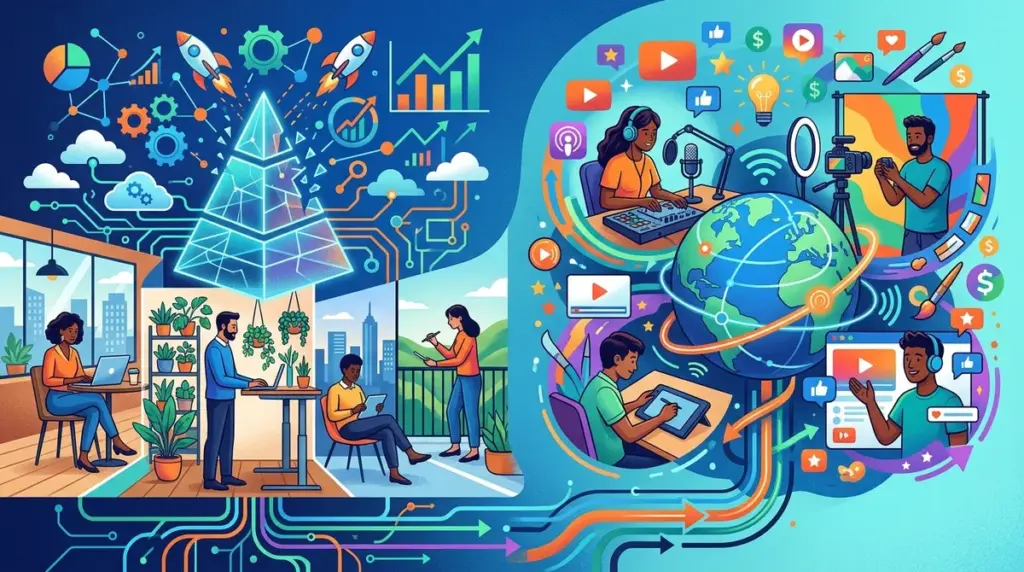
The geographic monopoly on innovation has collapsed. For decades, the "zip code advantage" dictated which startups received funding and which creators gained traction. If you weren't in San Francisco, London, or New York, you were fighting for table scraps. Remote work didn't just move meetings to Zoom; it decoupled talent from high-rent hubs, fundamentally altering the burn rates of startups and the distribution power of creators. This shift has forced a transition from "hustle culture" based on physical presence to a "results culture" based on digital output and verifiable expertise.
Capital Efficiency and the Global Talent Arbitrage
The most immediate impact of remote work on startup culture is the extension of the "runway." When a seed-stage company no longer has to pay $80 per square foot for a SoMa office or compete with Google’s local salary packages, its capital efficiency triples. Startups are now built as "global-first" entities, leveraging talent arbitrage to hire elite engineers in Warsaw, designers in Buenos Aires, and SEO strategists in Manila.
Best for: Bootstrapped founders and Series A startups looking to maximize their initial funding rounds without sacrificing talent quality.
- Reduced Overhead: Redirecting rent budgets into R&D or aggressive customer acquisition.
- 24/7 Productivity: Utilizing "follow-the-sun" development cycles where tasks are handed off across time zones.
- Retention through Flexibility: Offering lifestyle autonomy as a primary benefit, reducing the churn common in high-pressure tech hubs.
The Creator Economy as the New Marketing Department
As startups went remote, they lost the ability to build culture through office perks. Simultaneously, they lost the traditional "water cooler" word-of-mouth. To fill this void, startups have turned to the creator economy. We are seeing a merger where creators are no longer just "influencers" but are being integrated into the core growth loops of digital businesses.
From Brand Voice to Individual Authority
Modern startups are realizing that people follow people, not logos. Remote work allowed founders and early employees to build their own personal brands on LinkedIn, X, and Substack while working from anywhere. This has led to the rise of the "Founder-Creator," where the CEO’s audience serves as the primary distribution channel for the product. This reduces reliance on expensive PPC (Pay-Per-Click) campaigns and builds a more resilient, organic lead generation engine.
The Fractional Creator Model
Instead of hiring full-service agencies, remote-first startups are increasingly hiring "fractional creators." These are specialists who manage a specific niche—such as video production, newsletter growth, or community management—on a contract basis. This allows a startup to scale its marketing efforts up or down without the friction of traditional hiring and firing cycles.
Warning: The biggest risk in a remote creator-led strategy is "platform dependency." If your entire customer acquisition funnel relies on a single creator's access to a social algorithm, your business has a single point of failure. Diversify your "owned" media—specifically email lists and SEO-driven content—immediately.
The Documentation-First Culture
Remote work killed the "quick chat." In a distributed environment, information that isn't written down doesn't exist. This has birthed a new startup culture centered on documentation. Companies like GitLab and Zapier have set the standard, using massive public handbooks to manage thousands of employees across the globe.
Asynchronous Communication as a Competitive Edge
Startups that master asynchronous (async) communication move faster than those stuck in back-to-back meetings. Async culture requires employees to be better writers and clearer thinkers. For the creator, this translates to better content; for the startup, it results in a searchable internal knowledge base that makes onboarding new hires seamless. This shift has popularized tools like Notion, Loom, and Slack, which are no longer just utilities but the actual "office" where culture is built.
The Shift in Digital Real Estate and SEO
The creator-startup nexus has changed how we think about search and visibility. Previously, startups focused on "head terms" to compete with incumbents. Now, with a remote workforce capable of producing high volumes of niche content, the strategy has shifted toward "topical authority."
Creators within these companies are producing deep-dive white papers, case studies, and technical documentation that satisfy Google’s E-E-A-T (Experience, Expertise, Authoritativeness, and Trustworthiness) requirements. Because these creators are often experts in their fields, the content they produce is naturally more valuable than the generic "SEO filler" produced by traditional content mills. This has raised the bar for what constitutes "good" content in the tech space.
Scaling Your Digital Presence in a Post-Office Era
To thrive in this environment, startups and creators must stop trying to replicate the office experience online and instead lean into the advantages of decentralization. This requires a fundamental shift in how you measure success and manage your digital assets.
First, audit your communication. If a decision is made in a call, it must be summarized in a shared document. Second, empower your team to build their own professional presence; their growth is your company's distribution. Finally, treat your internal documentation as a product. The better your internal "wiki," the faster your remote team can execute without supervision.
The winners of the next decade will not be the companies with the coolest offices, but the ones with the most efficient digital workflows and the strongest network of creators. The "culture" of a startup is no longer found in the breakroom; it is found in the clarity of its documentation and the strength of its online community.
Frequently Asked Questions
How do remote startups maintain a cohesive culture without an office?
Culture in remote teams is built through shared values, transparent documentation, and intentional "social" syncs. It moves away from physical proximity and toward alignment on mission and output. Successful teams use "virtual offsites" and rigorous written communication to ensure everyone stays on the same page.
What is the biggest challenge for creators working with remote startups?
The primary challenge is "context collapse." Without being in the room, it can be difficult for creators to understand the nuances of a product or the founder's vision. This is why documentation and direct access to product leads are essential for any creator-startup partnership.
Does remote work make it harder to protect intellectual property?
It requires more robust digital security protocols. Startups must use encrypted tools, strict access controls (IAM), and clear legal frameworks for international contractors. However, the risk is generally outweighed by the ability to access global talent that can build more secure and sophisticated products.
How has remote work changed SEO for startups?
It has shifted the focus from local "near me" searches to global "how-to" and "authority-based" searches. Startups now compete on a global stage for every keyword, making high-quality, expert-led content more important than ever to stand out in a saturated digital market.