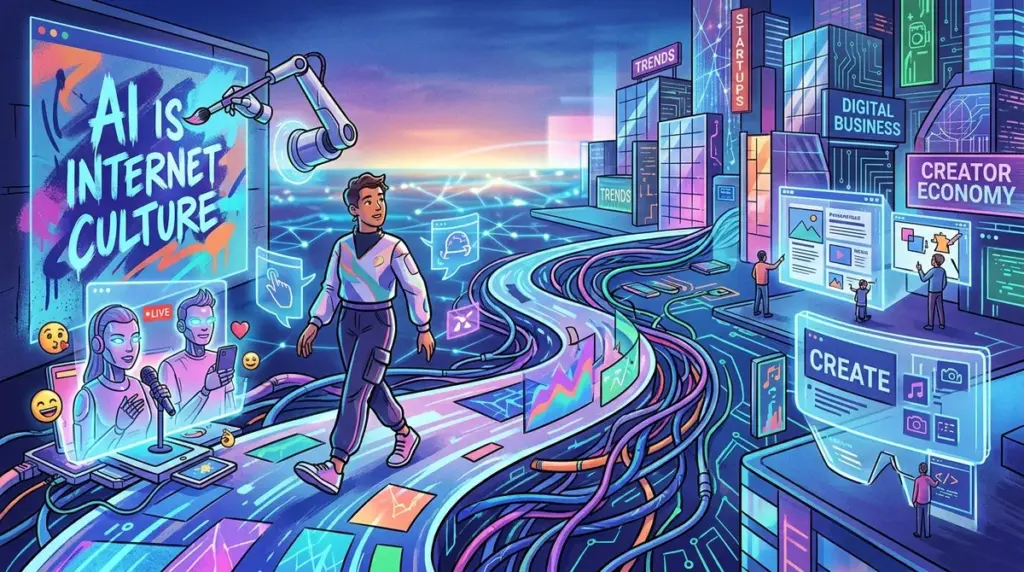
The transition of artificial intelligence from a specialized enterprise tool to a fundamental layer of internet culture happened almost overnight. For digital publishers, agencies, and creators, the shift isn't just about using a chatbot to draft an email; it is about a wholesale change in how information is produced, indexed, and consumed. We have moved past the "novelty" phase where AI-generated images were a curiosity. Today, AI is the infrastructure. It dictates the visibility of content through algorithmic curation and provides the raw materials for the viral cycles that define modern digital business. This pervasive integration raises fascinating questions about what AI's role in internet fame truly means for creators and audiences alike.
The Collapse of the Content Production Barrier
Historically, high-fidelity content required significant capital or specialized skill sets. Video editing, graphic design, and long-form technical writing had high entry costs. Generative AI has effectively flattened this barrier, commoditizing the "first draft." This democratization means that the competitive advantage has shifted from the ability to produce content to the ability to curate and verify it. In internet culture, this manifests as a flood of hyper-niche content that would have been financially unviable three years ago.
Best for: Small-to-mid-sized agencies looking to scale creative output without a linear increase in headcount.
The speed of this cycle is visible in meme culture. Trends that used to take weeks to evolve now move in hours because creators can generate high-quality visual assets instantly. For brands, this means the "window of relevance" for participating in cultural moments has shrunk. If your creative team takes 48 hours to approve a social post, the cultural conversation has already moved on, often driven by AI-assisted creators who hit the market in minutes.
Algorithmic Curation and the Feedback Loop
Every major platform—from TikTok to LinkedIn—now operates on a "black box" of AI-driven recommendation engines. This has fundamentally changed how SEO professionals and marketers approach distribution. We are no longer just optimizing for keywords; we are optimizing for "latent intent" and engagement signals that the AI prioritizes. The culture of the internet is now a feedback loop where AI creates content based on what the algorithm predicts will perform, and the algorithm learns from the AI-generated content's success. Understanding this dynamic is key to grasping why AI hype spreads easily on social platforms, creating a self-reinforcing cycle.
- Semantic Clustering: Search engines now group content by topic depth rather than exact keyword matches, forcing a shift toward topical authority.
- Predictive Personalization: Feeds are no longer chronological or social; they are interest-based, driven by deep learning models that analyze user behavior in real-time.
- Synthetic Media Saturation: A significant percentage of "stock" imagery and background music in short-form video is now AI-generated, creating a new aesthetic standard for "internet-native" content.
Warning: Over-reliance on AI-generated text without human editorial oversight leads to "semantic drift." When models train on other models' outputs, the nuance and factual accuracy of the content degrade, leading to a loss of brand authority and potential search engine penalties for low-value, unoriginal content.
The Rise of Synthetic Personalities and Virtual Influencers
Internet culture is increasingly comfortable with non-human entities. From VTubers to AI-driven brand mascots, the line between a human creator and a synthetic one is blurring. This is a massive opportunity for startups and digital businesses to create evergreen brand assets that don't quit, age, or involve the PR risks associated with human influencers. These synthetic personalities are integrated into Discord servers, Twitch streams, and Twitter threads, interacting with audiences at a scale that was previously impossible.
Best for: Community managers and creators looking to provide 24/7 engagement without constant manual intervention.
These entities are not just bots; they are data-driven characters. They can analyze sentiment in a comment section and adjust their "personality" or messaging to better align with the audience's current mood. This level of real-time cultural adaptation is the new benchmark for digital engagement.
Operationalizing AI in Digital Strategy
To stay relevant, digital businesses must move beyond using AI as a glorified spell-checker. The integration must be structural. This involves building custom workflows that use LLMs for data synthesis, trend analysis, and rapid prototyping. For example, an SEO agency can use AI to analyze thousands of search results to identify "content gaps" that a human might miss, then use that same AI to outline a 50-article cluster to dominate that niche.
The goal is not to replace the human element but to use AI to handle the high-volume, low-context tasks. This frees up human talent to focus on strategy, high-level creative direction, and the "human-in-the-loop" verification that prevents the brand from falling into the trap of generic, AI-sounding output. In a world of infinite content, the "human touch"—opinion, controversy, and unique insight—becomes the premium product.
Managing the "Dead Internet" Risk
As AI becomes more prevalent, the risk of a "Dead Internet"—where bots talk to bots and generate content for other bots—increases. For publishers, the defense against this is "Information Density." AI is excellent at summarizing existing knowledge but poor at generating new, primary-source information. To thrive, internet culture and the businesses within it must prioritize original reporting, unique data sets, and lived experience. These are the things that AI cannot currently replicate and what users (and search engines) will value most as the web becomes more synthetic.
Practical Steps for Immediate Implementation
For those managing digital properties, the focus should be on three specific areas of AI integration to remain competitive in the current cultural landscape:
First, audit your creative pipeline to identify where "bottleneck tasks" like image resizing, basic copy variations, or meta-tag generation can be automated. Second, invest in "Prompt Engineering" as a core competency for your team; the quality of AI output is directly proportional to the quality of the input. Third, establish a clear AI Ethics and Disclosure policy. As internet culture becomes more savvy, transparency about where and how you use synthetic media will build trust rather than erode it.
Frequently Asked Questions
How does AI impact the cost of SEO and content marketing?
AI significantly lowers the cost of production for high-volume content, but it increases the cost of "standing out." While you can generate more pages for less money, the investment required for high-level strategy, original data, and expert editing has increased because these are now the primary differentiators in a crowded market.
Will AI-generated content hurt my site's search rankings?
Search engines prioritize "Helpful Content" regardless of how it was produced. If AI content is generic, factually incorrect, or provides no new value, it will likely be de-prioritized. However, high-quality, edited AI-assisted content that serves the user's intent is currently treated the same as human-written content.
What is the biggest risk of using AI in brand communication?
The primary risk is a "homogenization of voice." Because LLMs are trained on average data, their default output tends to be average. Brands that rely too heavily on AI without strong editorial direction risk losing their unique brand identity and sounding exactly like their competitors.
How should creators handle the copyright issues surrounding AI?
The legal landscape is still evolving, but the current standard is that AI-generated output without significant human modification cannot be copyrighted in many jurisdictions. Creators should use AI as a tool for ideation and drafting, ensuring the final product contains enough human-authored elements to secure intellectual property rights.