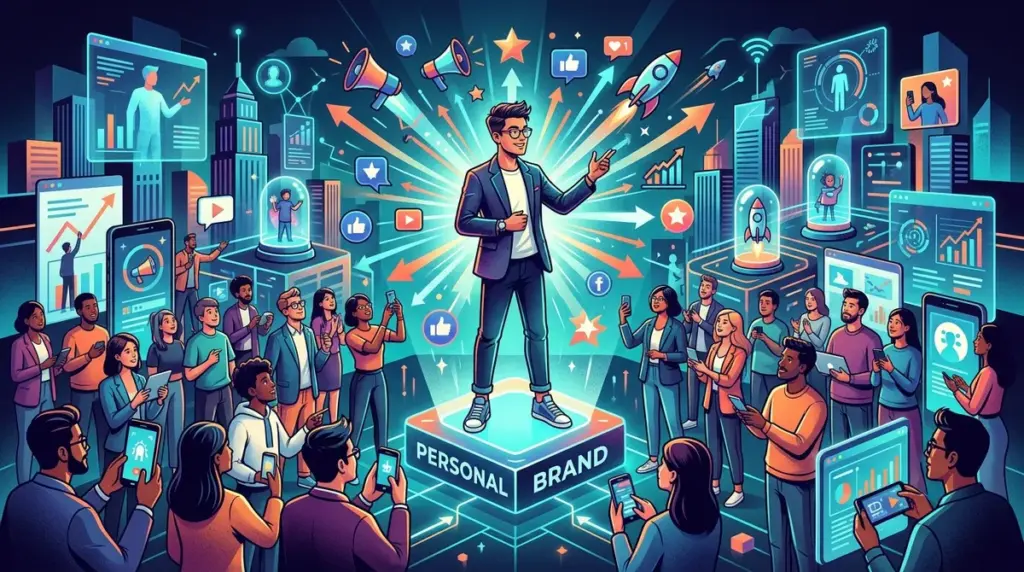
Ventures that rely solely on paid acquisition are currently fighting a losing battle against rising CPMs and decaying cookie-based tracking. For early-stage startups and growth-phase tech companies, the most efficient arbitrage for attention is no longer a polished corporate brand, but the personal brand of the founder or key engineers. This shift is driven by a fundamental change in how software is bought: buyers now vet the person behind the product before they ever request a demo. This focus on founder-led attention is a key way startups can ultimately beat big tech brands in the attention economy.
Best for: Seed to Series B startups looking to reduce Customer Acquisition Cost (CAC) and establish category authority without a seven-figure marketing budget.
The Arbitrage of Founder-Led Distribution
The corporate LinkedIn page is a graveyard for engagement. Algorithms across X, LinkedIn, and even specialized platforms like Polywork explicitly de-prioritize company-branded content in favor of individual profiles. This isn't just a quirk of the code; it is a reflection of user behavior. Users crave the "messy middle" of company building—the technical hurdles, the failed pivots, and the contrarian takes that a legal-vetted corporate account would never be allowed to post.
By leveraging a personal brand, a founder can bypass the traditional ad auction. When a CEO shares a deep dive into how they solved a specific database latency issue, they aren't just "posting content." They are creating a high-intent lead magnet that signals technical competence to potential hires and reliability to potential customers. The cost of this distribution is time, rather than direct spend, making it the most scalable asset on a startup’s balance sheet.
Lowering CAC Through Narrative
Traditional B2B marketing often requires multiple touchpoints before a lead enters the CRM. A founder with a strong personal brand compresses this funnel. If a prospect has followed a founder’s journey for six months, the trust is already established. The first sales call isn't about "Who are you?" but "How do we implement this?" This pre-sold state significantly reduces the sales cycle length and increases the lifetime value (LTV) to CAC ratio.
The Mechanics of Building in Public
The term "building in public" is often misunderstood as a requirement to share sensitive financial data. In reality, it is about documenting the decision-making process. For technical startups, this means sharing the "why" behind the tech stack. For D2C or creator-led ventures, it involves showing the supply chain or the design iterations.
Best for: Technical founders who want to attract high-level engineering talent and early adopters who value transparency.
To operationalize this, startups should focus on four specific content pillars:
- The Technical Deep Dive: Explaining a specific engineering challenge and how it was overcome. This builds authority with the "user" persona.
- The Industry Contrarian: Challenging a status quo in the sector (e.g., "Why SaaS seats are a dead pricing model"). This builds authority with the "buyer" persona.
- The Behind-the-Scenes: Sharing the mundane aspects of growth, such as hiring frameworks or board deck preparation. This builds authority with investors and peers.
- The Personal Manifesto: Why the company exists beyond the pursuit of profit. This builds long-term brand loyalty.
Establishing Proof-of-Work via Social Proof
A personal brand acts as a living resume and a real-time white paper. When a founder consistently provides value through insights, they are providing "proof-of-work." This is particularly critical in crowded markets like AI or FinTech, where product features are easily replicated but a founder’s unique perspective and the community they’ve built around it are not.
Warning: Avoid the "Influencer Trap." If your personal brand becomes entirely about your lifestyle rather than your industry expertise, you will attract followers but fail to convert customers. Every piece of content should tie back to the problem your startup solves, even if indirectly.
Operationalizing Influence Without Sacrificing Product Focus
The primary objection from founders is that they don't have time to be "content creators." This is a false dichotomy. The most effective personal brands are built on documentation, not creation. By using a "Create Once, Distribute Everywhere" (CODE) framework, a founder can turn a single internal memo or a weekly team sync into a month’s worth of social content.
For example, a founder can record a 5-minute Loom video explaining a new feature to the sales team. That video can be transcribed into a long-form LinkedIn post, edited into a short clip for X, and expanded into a newsletter entry. This ensures the founder stays focused on the business while the marketing team or a specialized ghostwriter handles the distribution logistics.
Mitigating the Risks of Founder-Centric Branding
The "Key Man Risk" is the most significant downside to this strategy. If the brand is entirely tied to the founder, the company’s valuation may suffer if that founder exits. To counter this, smart startups encourage "Employee Advocacy." By helping key employees—such as the Head of Product or a Lead Engineer—build their own personal brands, the company creates a decentralized network of influence. This decentralized approach to personal branding also mirrors the rise of community-led startups gaining momentum.
This "network of experts" model is more resilient than a single-founder model. It distributes the brand equity across the organization and makes the company appear as a hub of talent rather than a one-man show. It also serves as a powerful retention tool; employees who are recognized as industry thought leaders are often more engaged and loyal to the firm that helped build their platform.
Deploying the Personal Brand Strategy
To move from theory to execution, startups should treat the personal brand as a product launch. This requires a dedicated cadence and measurable KPIs that go beyond vanity metrics like "likes." Focus on "dark social" signals: how many inbound DMs are from qualified prospects? How many podcast invitations are being received? How many candidates mention a specific post in their interview?
Start by identifying the one platform where your customers actually spend their professional time. For B2B, this is almost exclusively LinkedIn. For DevTools, it is X and GitHub. For creative agencies, it is Instagram or TikTok. Master one channel before diversifying. The goal is to become the "default" person that comes to mind when a specific industry problem is mentioned.
Founder Branding FAQ
Does the founder have to be the face of the company if they are introverted?
No. Personal branding for introverts often works better because it tends to be more data-driven and technical. You don't need to be on camera; high-quality written threads or deep-dive technical essays are often more effective for B2B sales than "vlog-style" content.
How much time should a founder realistically spend on this?
Aim for two hours per week of "active" time. This includes one hour for a deep-dive writing session or video recording, and 15 minutes a day for engaging with comments. The rest—formatting, scheduling, and cross-posting—should be delegated to a marketing lead or an agency.
What happens to the brand if the startup pivots?
This is the hidden advantage of a personal brand. While a company brand is tied to a specific product, a personal brand is tied to an individual’s expertise and journey. If the startup pivots, the founder’s audience usually follows, because they are invested in the founder’s problem-solving ability, not just the specific software they are currently selling.