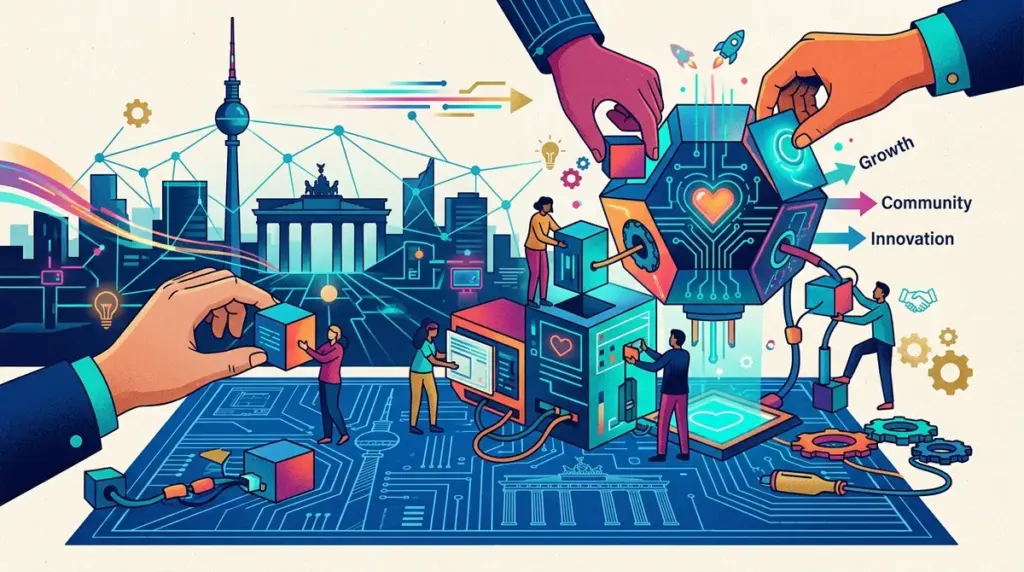
Berlin’s transformation from a fractured, post-Cold War landscape into Europe’s primary startup hub was not an accident of geography. It was a calculated arbitrage of low operational costs, a surplus of creative talent, and a specific "copy-and-scale" methodology that defined the early 2010s. For founders and investors, Berlin represents a strategic hedge against the hyper-inflation of Silicon Valley and the regulatory complexity of London. It offers a 30% to 40% discount on burn rates compared to San Francisco, while providing frictionless access to the European Single Market.
The city’s identity is built on three distinct pillars: the legacy of the "Clone Factory," the influx of international talent seeking a specific lifestyle-to-income ratio, and a maturing ecosystem that has moved from e-commerce clones to deep tech and fintech powerhouses. Understanding this trajectory is essential for any digital business looking to plant a flag in the DACH region (Germany, Austria, Switzerland).
The Rocket Internet Legacy and the Industrialization of Startups
The foundation of Berlin’s startup identity is inextricably linked to Rocket Internet and the Samwer brothers. In the late 2000s and early 2010s, Berlin became known as the "Clone Factory." The strategy was clinical: identify proven American business models—like eBay, Zappos, or Airbnb—and replicate them with aggressive operational efficiency in markets the US giants had yet to penetrate.
While critics dismissed this as unoriginal, it served a vital commercial purpose. It industrialized the startup process in a city that lacked venture capital history. Companies like Zalando and HelloFresh emerged from this era, not as innovators of technology, but as masters of logistics and performance marketing. This period built a massive pool of middle-management talent that understood how to scale operations across multiple European borders simultaneously. Today, the "Rocket Mafia"—former employees of these early clones—are the founders and angel investors driving the current wave of Berlin startups.
The Cost-to-Talent Ratio as a Competitive Advantage
Berlin’s primary draw for a decade was its affordability. While that gap is closing, the city remains a high-value proposition for seed and Series A companies. The "poor but sexy" moniker, coined by former Mayor Klaus Wowereit, translated into a commercial reality where a startup could hire three senior engineers in Berlin for the price of one in Palo Alto.
The English-First Ecosystem
Unlike Paris or Munich, Berlin’s startup scene operates almost exclusively in English. This lowered the barrier to entry for international talent, allowing the city to drain brains from Southern and Eastern Europe during economic downturns. Best for: Rapidly scaling engineering teams without the immediate need for German language proficiency. This internationalism has created a feedback loop: more international talent leads to more diverse perspectives, which in turn makes the city more attractive to global VC firms like Sequoia and Accel, who now have a permanent presence in the city’s ecosystem.
Venture Capital Density in Mitte and Kreuzberg
The physical concentration of the industry is a force multiplier. Most of Berlin’s tech infrastructure is clustered in two districts: Mitte and Kreuzberg. This density facilitates "knowledge spillover"—the informal exchange of information between founders, developers, and investors in shared spaces like Factory Berlin or the Soho House. This proximity reduces the friction of networking and accelerates the due diligence process for local investors like Cherry Ventures or Point Nine Capital.
Warning: The "Berlin Trap" – Founders often over-index on the city's lifestyle and "cool factor," leading to a stagnation in the seed stage. Berlin has a high density of startups but a historically lower conversion rate to Series C and beyond compared to London. Don't mistake a high headcount in a Kreuzberg loft for actual product-market fit.
The Pivot to Deep Tech and Fintech
Berlin has successfully outgrown its reputation for simple e-commerce. The current identity is defined by "Deep Tech"—AI, blockchain, and quantum computing—alongside a dominant Fintech sector. The presence of N26 and Trade Republic has turned Berlin into a global center for consumer finance innovation. These companies didn't just copy US models; they rebuilt the banking stack to comply with stringent German and EU regulations, creating a "defensibility moat" that US competitors struggle to cross.
- N26: Redefined mobile banking for the Eurozone, focusing on cross-border functionality.
- Trade Republic: Democratized capital markets in a country traditionally risk-averse to stock trading.
- Contentful: Pioneered the "headless CMS" category, proving Berlin can produce world-class B2B SaaS.
- Tier Mobility: Leveraged Berlin’s urban density to lead the micro-mobility sector before its merger with Dott.
Navigating the German Bureaucracy
Despite the digital-first nature of the startup scene, the German state remains heavily paper-based and bureaucratic. This is the "Berlin Tax." Founders must navigate the Ausländerbehörde (Immigration Office) for talent visas and the Notar (Notary) system for every funding round or share transfer. This friction is a significant hurdle for non-EU founders. However, the German government’s "Digital Hub Initiative" and the "Future Fund" are beginning to inject billions into the ecosystem to mitigate these structural weaknesses and compete with the US and China.
Strategic Moves for Entering the Berlin Market
For agencies and publishers looking to engage with this market, the approach must be localized but not necessarily German-language focused. The Berlin identity is pragmatic and data-driven. Marketing to this crowd requires a focus on operational excellence and "Founders-first" narratives. If you are selling services to this hub, emphasize your ability to navigate the specific regulatory landscape of the EU (GDPR, BaFin) while maintaining the speed of a Silicon Valley operation.
To win in Berlin, you must integrate into the community hubs. This means more than just attending conferences like TOA (Tech Open Air); it means active participation in the Slack communities and private founder circles that govern the city's deal flow. The city rewards those who contribute to the ecosystem's maturity rather than those who merely treat it as a low-cost labor pool.
Berlin Startup FAQ
Is Berlin still affordable for new startups?
While commercial rents in Mitte and Kreuzberg have spiked, Berlin remains significantly cheaper than London, Paris, or Zurich. The real cost-saving is in the salary expectations, which, while rising, are still anchored by a lower cost of living compared to global tier-1 tech hubs.
Do I need to speak German to start a business in Berlin?
For day-to-day operations and hiring within the tech scene, English is the standard. However, for legal, tax, and administrative tasks, German is often mandatory. Most successful international founders hire a local "Relocation Agent" or a German-speaking COO to handle the Bürokratie.
What is the biggest challenge for Berlin-based companies?
The "Growth Gap" is the primary hurdle. While Berlin is excellent at nurturing companies from 0 to 1, the availability of late-stage (Series D+) capital is lower than in the US. Many Berlin "unicorns" still look to US-based private equity or the NASDAQ for their exit strategies.
Which sectors are currently dominant in Berlin?
Fintech, Healthtech, and Climate-tech are the current leaders. Berlin has become a center for "Impact Investing," with a high concentration of startups focused on carbon accounting, renewable energy management, and sustainable supply chains.