

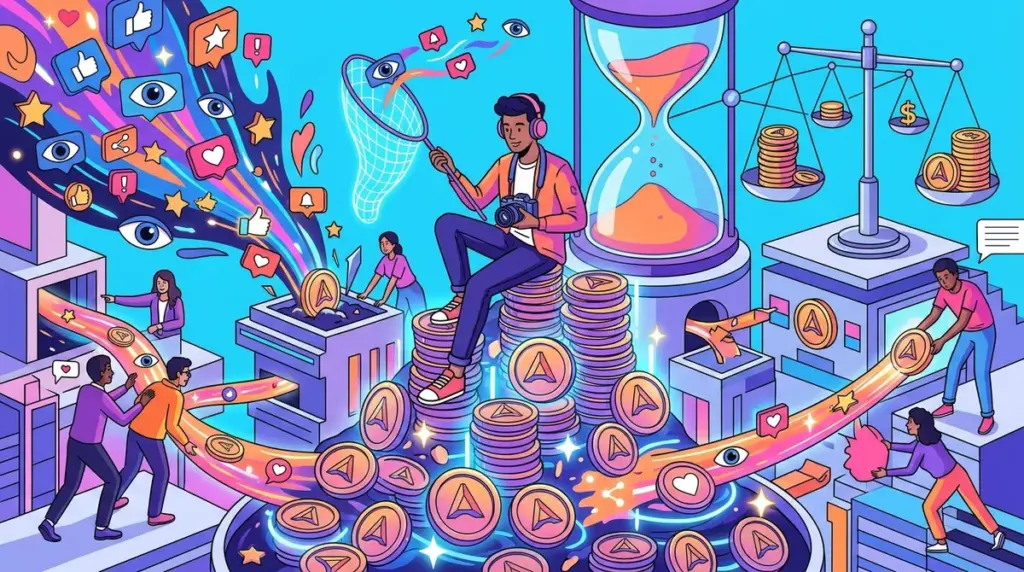
The traditional marketing funnel is collapsing because the top-of-funnel entry point—the impression—has become functionally worthless. For a decade, digital strategy relied on the assumption that visibility equaled value. If a million people "saw" a banner or a social post, the campaign was a success. Today, that logic is a liability. In an era of infinite content supply and finite human cognitive capacity, the only metric that correlates with revenue is active attention. If you cannot hold a user for more than three seconds, your "reach" is merely a rounding error in a platform's quarterly earnings report.
The Structural Shift from Reach to Retention
The pivot from a "social graph" (who you follow) to an "interest graph" (what you actually watch) has fundamentally rewired the internet's economy. Platforms like TikTok and YouTube Shorts have proven that user intent is less important than algorithmic resonance. For marketers and publishers, this means the cost of acquisition is no longer tied to the bid price alone, but to the content’s ability to prevent a scroll-past. When an algorithm detects a high drop-off rate in the first 1.5 seconds, it effectively de-indexes that content from the feed, making the cost of "boring" content infinite.
Best for: Growth leads and content strategists who need to justify higher production budgets for high-retention assets over high-volume, low-quality output.
The Math of the Three-Second Hook
Data from major social platforms suggests that if a video retains a viewer past the three-second mark, the probability of them reaching the 30-second mark increases by over 60%. This isn't just a creative challenge; it is an economic one. Every millisecond of friction—whether it’s a slow-loading hero image or a generic intro—acts as a tax on your attention capital. In the attention economy, your "currency" is the user's dopamine and time. If you don't provide an immediate return on that investment, they "spend" their time elsewhere.
Technical Performance as an Attention Lever
We often treat technical SEO and site performance as backend maintenance, but they are actually front-line attention tools. A site that takes three seconds to load isn't just slow; it is actively hemorrhaging the most valuable resource you have. Google’s Core Web Vitals—specifically Largest Contentful Paint (LCP)—are essentially proxies for measuring how quickly a site can capture a user's focus before they bounce back to the SERP.
Warning: High bounce rates are often misdiagnosed as "bad content" when they are actually "bad delivery." If your LCP exceeds 2.5 seconds, you are losing 30% of your potential attention before a single word of your copy is read. Optimize the delivery pipeline before you rewrite the headline.
To audit your attention efficiency, track these specific metrics rather than raw pageviews:
- Dwell Time vs. Bounce Rate: High dwell time on long-form content indicates deep attention, even if the total traffic volume is lower.
- Scroll Depth: Use heatmaps to identify the "attention cliff"—the exact point where users lose interest in your narrative.
- Returning Visitor Ratio: This measures "earned attention." If users return without a paid prompt, you have moved from a transactional relationship to a brand-based one.
- Micro-Conversion Rate: Tracking newsletter sign-ups or internal link clicks per 1,000 visitors provides a clearer picture of engagement than a generic "session."
The Rise of the Niche Authority Moat
As general attention becomes more expensive to buy through ads, smart players are building "attention moats" through niche authority. Broad-market publishers are struggling because they are competing for "cheap" attention that doesn't convert. Conversely, creators and B2B brands that dominate a specific, narrow vertical can command higher premiums because their audience's attention is highly qualified.
This is why we are seeing a massive shift toward "owned" attention channels. Newsletters, private Discord communities, and proprietary data reports are the new gold standard. These channels bypass the algorithmic gatekeepers that tax your reach. When you own the distribution, the value of each second of attention stays with your brand rather than being siphoned off by an ad auction.
The Creator-Led Business Model
Startups are increasingly hiring "Creators in Residence" because individuals are better at capturing attention than logos. A human face and a specific voice provide a "hook" that a corporate brand cannot replicate. This isn't about influencer marketing; it’s about integrating the mechanics of personality-driven content into the core of the business. The goal is to transform "rented" attention from social platforms into "owned" attention in a CRM.
Operationalizing Attention for Your Digital Strategy
To survive the next shift in the digital landscape, stop optimizing for the click and start optimizing for the stay. This requires a radical shift in how content is briefed and measured. Instead of asking "How many people will see this?", ask "How long will they stay, and what will they do next?"
Start by auditing your existing top-performing pages. Are they high-traffic but low-engagement? That is a leaked bucket. Use those pages to bridge the gap to high-value, high-retention assets. Implement "attention triggers"—interactive elements, high-quality video embeds, or unique data visualizations—that force the user to stop scanning and start consuming. In a world of infinite noise, the loudest voice rarely wins; the most captivating one does.
Frequently Asked Questions
How do attention metrics differ from traditional engagement metrics?
Traditional engagement (likes, shares) can be "hollow" or performed without actually consuming the content. Attention metrics, such as dwell time and active scroll depth, measure the actual time a user spends processing the information, providing a more accurate picture of brand impact.
Is long-form content still viable in an attention-scarce economy?
Yes, but the entry point must be frictionless. Long-form content often sees higher conversion rates because it builds deeper trust. The key is to use "modular" design—clear subheadings, bullet points, and summaries—that allow users to commit their attention in stages rather than all at once.
What is the biggest "attention killer" on modern websites?
Intrusive UX elements like aggressive pop-ups, slow-loading video ads, and layout shifts (CLS) are the primary drivers of immediate bounces. When the technical experience frustrates the user, they will withdraw their attention instantly, regardless of the content's quality.
How can small brands compete for attention against massive budgets?
Small brands should focus on "depth" over "width." By dominating a specific niche and providing high-utility, specialized information, a small brand can capture the high-value attention of a specific demographic that larger, more generalized competitors often overlook.